It’s been quite a while since I posted here. This is not because there’s been nothing to rage about – it may possibly have been because there’s too much. I have yet to find words for Bibby Stockholm syndrome, to pick but one issue out of the jar … but I have been writing a poem, and thought I would share it here.
Diogenists amongst you will likely spot the poem’s oblique reference to that old-school barrelman, because a pivotal moment in his story comes when he pages the oracle at Delphi and gets the puzzling exhortation to go forth and do what he thought he’d already got done for: namely, to ‘deface the currency’.
For all we know today, the Pythoness (the priestess of the temple, who channelled the word of Apollo) may have been looking backwards into his story rather than forwards – or the priests who used to scribe and reformulate her words may have misheard – but Diogenes takes it that he must deface the political currency, and thus a legend is born …
This poem plays on the fact that the area of Paris known as Montparnasse, where a famous and beautiful cemetery is located, is named for Mount Parnassus in Greece, upon the slopes of which the temple of Apollo at Delphi was built. The Greek peoples of those times believed that the site of the temple was the centre of the world as marked by Zeus and that the stone (‘omphalos’) that he placed there was the world’s belly-button – and that this is why the Word of Apollo could be heard so clearly.
This particular Barrelman has never yet visited Delphi, but I have more than once had the good fortune to be able to wander around Montparnasse – and so here is my poem, and I hope you enjoy it:
Omphalos
I.
By the Seine we are secret lovers
let suddenly loose. We float lazily
about the citadel, fey and febrile
as the river’s grey surge and swell;
we sip coffee at Les Deux Magots, spy
something magical
glittering in the eyes of each passer-by,
drift hazily down the Rue Mouffetard
towards the catacombs, and all the while
I dare not forgo the feral heat
of your hand in my hand – we are Héloïse
and Abelard – we are Bogart and Bacall –
we are Jean-Paul and Simone –
no doom may daunt us, no death outrun us.
At Montparnasse cemetery, in the orange gleam
of a faltering mid-September sun, we flit between
the tombs and ossuaries like zephyrs,
fleet and phantasmagorical,
whispering with the shades of Baudelaire
and Beckett, sifting the leavings of grass and gravel,
lifting dust and petals from the graves. Feeling our way
to the far wall, we place two twenty-centime pieces
on the bed that Sartre and de Beauvoir share –
wishing on a morning’s quiet miracle.
II.
Tracing tired steps
back towards the Latin Quarter,
we chance upon a backstreet stairway, a door
stood ajar, warm air rising from a basement bar,
a saxophone dancing, splintering the stillness
of the midnight in soaring lyrical
frenzy, and I conjure an image
of the Pythia at Delphi, the cadences
of her vocalisations like trailing vines
snaking between the cracked and crooked
ancients of the olive groves, her wailing
words like strings of coracles
bobbling, riding torrents of breath,
cascading down Mount Parnassus
towards the banks of the Pleistos – writhing
in delirious inspiration, veiled in flame,
wreathed in the fumes of volcanic vents –
her serpentine divinations, allegorical
and tenebrous, woven into parables
for philosophers to parse, or princes to puzzle –
a sulphurous jazz priestess of the high passes,
a bebop Pythoness jiving at the world’s navel,
improvising the cryptic Apollonian
song-lines of her oracle.
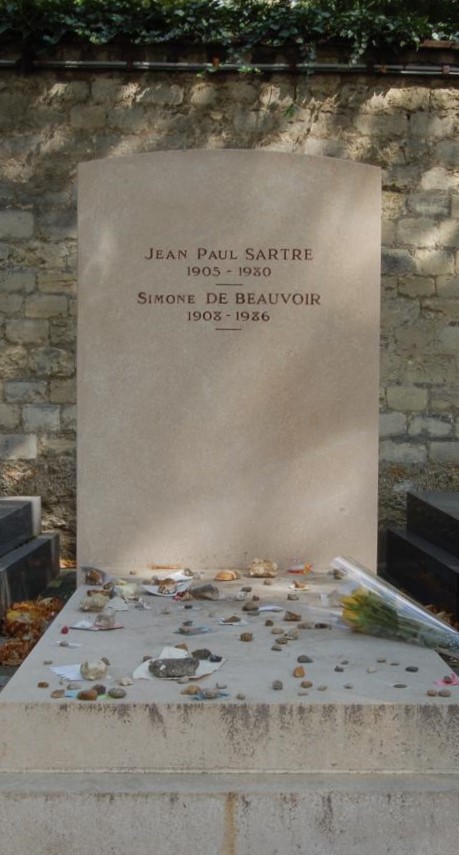
The image of the tomb of Sartre and De Beauvoir was taken by Angela Signorastri. The image of the temple ruins at Delphi is by Luarvik/Wikimedia, reused under creative commons licence: https://commons.wikimedia.org/wiki/File:The_Temple_of_Apollo_at_De: lphi.jpg
 Barrelblog