Buried services

My illustrious, or maybe that should read ‘deservedly notorious’ forebear, Diogenes the original Barrel Man, was once hanging loose in Corinth when that city came under siege. The good citizens threw themselves into a great frenzy and tumult of defensive, albeit possibly self-defeating preparations. Diogenes, in bedraggled response, took to rolling and beating his barrel up and down the main drag, back and forth, repetitively – doggedly, as was his wont and constant practice.

The Corinthians paused a moment to enquire what, if he pleased, he thought he was about. Didn’t he know there was a war on? Diogenes thought for a moment and then satirically responded: “I’m just trying to look as busy as you lot”. (My colleague Caroline Pelletier has written about this story in much greater depth here.)

I have this story very much in my mind of late because a couple of months ago, at the end of March 2025, my own prolonged barrel-roll, in one particular NHS citadel – which here shall be dressed in a fig leaf of notional anonymity, lest its surveillance bots and drones come a-whirring after me – came to an end, after twenty-four years and 340-odd days up and down, up and down Main Street…

Yes – Barrelman has marked the advent of his 60th birthday by resigning his post, and is now the proud possessor of a shiny new bus pass, and a proportion of an NHS pension. Diogenes himself of course would be turning in his grave, should he ever happen to hear about this damning evidence of grievous compliance with and dependence upon the system, but the fact is that my old knees are almost as dodgy as his were and I lack his planet-size stamina and proto-Stoicism – so I’ll perhaps be getting out a bit less, going forward.

A mere month or so is hardly yet long enough in which to digest and make some sense of twenty four years of the complicated dynamics and ethics of taking a pay cheque from said Establishment. Was I rolling my barrel performatively, or parodically, or was there some other point or purpose? Or was I kidding myself, and it was more that the Citadel was rolling me around, from one end of the road to another, guarding against the possibility that I might come to rest somewhere and really cause havoc?

Reader, for better or for worse, I tarried there. Let me tell you a bit of my story, and do some of my digesting out here in the agora, and you be the judge, and your reading will help my processing, and so I thank you, whatever may be your judgement. I venture to suggest that it may be of some historical interest to track a quarter century of NHS specialist services through the admittedly outlier lens of my own ‘journey’.

If you have somewhere to be getting to, park that thought, if you would be so kind – for we may be some time, as my story seems to be growing in the telling…

***************

I began my NHS career ‘proper’ as a locum Mental Health Practitioner with the Outreach Team of (I do declare) an internationally renowned NHS Democratic Therapeutic Community (‘DTC’) in April 2001 – four sessions a week, which is four half-days in NHS language. I was covering someone’s maternity leave, and not imagining I’d be sticking around for long; but before that person came back from leave, someone else was off long-term sick, and then someone else’s post couldn’t be recruited to, and three things led to a fourth and suddenly I had clung on to that role and made myself useful enough for long enough to secure employment rights (a thing that is very rarely allowed to happen these days).
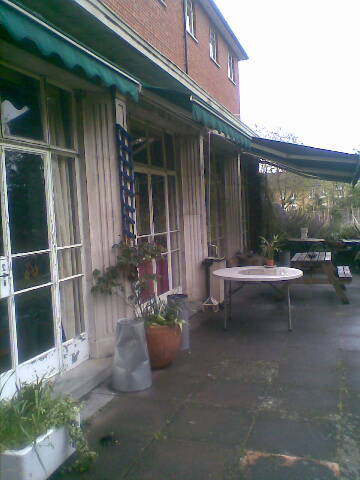
The DTC – the patio

That was my first paid NHS post, after five years of honorary psychotherapy work in a Central London Community Mental Health Team (and not counting (in about 2000-2002) a stint of NHS sub-contracted work as a primary care counsellor in a GP practice, also in Central London) – and before that a decade in front line ‘direct access’ and supported housing projects for the homeless.

Then in July 2002, I started a second post (in the same NHS Mental Health Trust that in those days had the management of (let’s hesitate to say ‘managed’) the DTC) – a further three sessions a week, as a group psychotherapist with the adult Eating Disorders Service (EDS), also of international reputation, it so happens, and again in a particular NHS hospital setting in London.

It’s perhaps worth pausing here to say a couple of things about this second post (it came later than, but ran alongside, the DTC Outreach job). The first is that the EDS job was quite unusual in having specified the wish to recruit a group psychotherapist to provide group psychotherapy. That doesn’t happen nearly as often as one might imagine (the idea persisting in some circles that any old merry old soul can run a group, whereas ‘one to one’ therapy is for the grown-ups).

Full marks, then, to the EDS – that said, it turned out that what was actually wanted, was a group psychotherapist to supervise other people running groups – concretely, by observing groups through a one-way mirror, and then discussing afterwards, with the co-therapists who had run the group in the room, what had ‘taken place’.

This, dear reader, was a mad plan – on so many levels, I scarcely know where to start. Suffice to say, staring through a one-way mirror from an invisible chair was not a great way to help extremely vulnerable women (almost exclusively) in states of malnutrition to feel comfortable about or in themselves. It took me nearly a year, as I recall, to mobilise and make and win the argument for not doing it this way, and for me to come into the groups as one of the co-therapists.

The other thing to say about the EDS at that time was that it was in a period of rapid change (which is usual in the NHS, but still important to underline). In 2002 it was still a matter of recent memory (especially, of course, to the more veteran patients) that sufferers from ‘anorexia nervosa’ (I’m going to use a fair bit of ironic distance, to signify the use of terms which in other kinds of essays I usually would want to critically deconstruct) would be placed on enforced bedrest until they had been ‘re-fed’ to a ‘normal’ Body Mass Index.

Also, ‘Austerity’ was impending in the wider world, but not yet upon us, and while it would be wrong to say that money was no object, the Service had a charismatic and powerful medical lead of long standing, in turn the inheritor of the legacy of a previous such leader. They kept the bureaucrats mostly at bay, although I’m sure it took its toll, and mostly they got what they wanted.

And so, to get to my particular point, patients referred for assessment were ‘cherry-picked’ for motivation for ‘full recovery’ and likely to find themselves discharged, if they did not pleasingly improve, for not being ‘in alliance’. There was no force-feeding (not directly, in the sense of ‘restraint’ and ‘bolus’ feed – this was in those days, if ever felt to be needed, in effect subcontracted out to (or projected into, to use other language) the local general hospital’s Intensive Care Unit); and the patients were streamed according to presenting symptomatology (it was still in those days possible to have inpatient treatment for so-called ‘bulimia nervosa’).

Lastly, for now, treatment was long, and aimed at something that was loosely thought of as a ‘full re-boot’ – ‘weight restoration’, ‘symptom elimination’, the full range of psychotherapies and occupational therapies, day treatment run from the ward and then three years of outpatient follow-up.

A transition group ran from the day patient stage, which was of varying length, and then for a full year into the outpatient stage. This was the group that I led on – the other group being one of the two inpatient groups (there was one for ‘restrictive’ patients and one for ‘multi-impulsive’ patients).

***************

It was perhaps a happy conjunction that in my other post, with the Outreach team of the DTC, I was from about 2003 also co-therapist in what was called in that service the Leavers’ Transition Group, which in similar fashion ran from the last three months of one’s year of residential therapy and for the first six months post-discharge.

A very particular specialism, then: working across two inpatient or residential treatment centres, very different in task and nature (especially hierarchically speaking!) and philosophy, but both concerned with mitigating in some way the perennial problem of the ‘big bump’ in intensity of intervention from inpatient to outpatient care, that is well understood to be contributory both to the high risk of relapse and sometimes suicide of ‘mental health’ patients immediately post-discharge, and to the related phenomena of ‘revolving doors’ and of (to use yet another awful term, but this is a blog, not a book, and I must keep the story moving) ‘institutionalisation’.

***************

The NHS Trust in question was a pilot site for the introduction in 2004 of the Agenda for Change nationwide payscale (for all disciplines except medicine and dentistry and some very senior managers, we should note, because those guilds were powerful enough to be able to continue to do their own thing). I was ‘banded’ then across both posts as Principal Adult Psychotherapist. I did not have a ‘core profession’, being what in Freud’s day was called a ‘lay psychotherapist’ (which then meant ‘not a doctor’ and now means ‘not a doctor, nurse, psychologist or social worker’), but was ‘grand-parented in’ to the new system on the basis of the adjudicated ‘equivalence’, with a professional qualification, of my previous mental health and social care experience.

I can only really say here that I was very fortunate, and in the right place at the right time. My generation is the last that remembers what it was like before ‘A4C’, and the oddness of my own journey couldn’t now be replicated (which may or may not be a good thing!). In my memory of the process, there was a kind of feeding frenzy, at both individual and guild levels, as everyone (me of course included!) scrambled, predictably enough, for the best rock to perch upon in the new order.

‘Psy-‘ professionals got pretty good deals (compared, say, to nurses) and the medium to long term consequences (in a nutshell, pricing ourselves out of the market, so that new generations of lower-paid psy professionals had to be introduced to make the work affordable – this, and the exacerbation rather than mitigation of interprofessional rivalries – and I think also the gradual degradation in the way that nurses are valued in the system of care (as opposed to outside of it)) were not really properly considered and perhaps would have been hard to foresee.

***************

The years 2006-2008 were dominated for me, and for many others of course, by the long and grim process that led to the closure of the DTC. This was a cataclysm that I have written about elsewhere, including on this weblog, and I won’t repeat all of that here, massively important though I consider that part of the story to be.
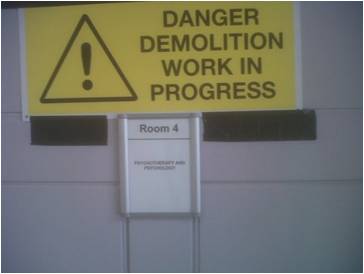
Demolition job at the Citadel (photo by Martin Wrench)

For me, I must own, the grieving continues – and so, via an ongoing oral history, archiving and activism project which I am involved in with colleagues who lived at or worked at the DTC, does the work (that is another, ongoing story!) (I should also mention that the above image was shared with me by the late Martin Wrench, social worker and therapist with the Outreach Team and much beloved comrade.)

I have written before, with Chris Scanlon, my longstanding partner in crime, on the theme of ‘consulting to the out-group‘. Whilst many other services, especially ones that look like they are psychological therapy services of different kinds, routinely offer consultation to the referring service on the ‘difficult patient’ (yes, sorry to say!), the Outreach team offered, in effect, consultation to the potential patient, as to how to negotiate the difficult service.

For the Outreach client, there usually had been a long list of these, but typically (if you forgive for the moment my generalisation) they found themselves caught between Scylla and Charybdis. In the left hand corner, Scylla the sea-monster was represented by a local referring service that often felt they had ‘done all they could’ and wanted to ‘project’ the sufferer away into residential therapy ‘somewhere else’ (and the DTC was a national, and in those days nationally-commissioned service, so sometimes ‘somewhere else’ was a very long way away indeed).

Also, these were the days of so-called ‘world-class commissioning’ – a Blairite coinage, long before Johnson got in on the hyperbole, and the shift in the wind of commissioning towards ‘local services for local people’, while not by any means a toxic notion in itself, was part of what sounded the death-knell for an essential national service that had to be travelled to.

In the opposite corner, Charybdis the infernal whirlpool was a DTC with (to put it mildly) a bizarre-sounding offer of a year’s inpatient stay, far from home, no individual therapy, everything in groups and community meetings, no psychotropic medication, no ‘conditions or coercions’ such as sections of the Mental Health Act or Probation Orders, no locks on bedroom doors and no control, on the part of the staff team, as to admission or early discharge (all such matters being decided by majority vote of the DTC, with residents always in the majority in the electorate).

The Outreach team had the role, and the opportunity, to ‘get alongside’ the individual in this metaphorical Strait of Messina (as Alexander got alongside my forebear in his barrel in the marketplace) and think with them about their dilemma, about how far ‘in from the cold’ it might feel safe enough to venture. The consultation still happened across a power difference (this being very much the norm) but it had, at least from time to time, the effect of disrupting the way power operated in the story.

It stayed with me as a practice, so that later on, in my time at the hospital of which I speak, when asked for example to ‘assess’ the ‘difficult patient’, I would try to take the same approach, of sitting with the individual and jointly assessing with them the chaos or hostility of the system of care around them, thinking with them about what choices they might have or could reach for in such circumstances.

The second point connects to this first: those consultations were almost always set up with two ‘clinicians’ present – for various reasons, I think – one being the sort of fear and dread associated with the ‘one to one’ encounter across a power difference (concerning abuse, and the evocation of abuse), that precluded individual therapy sessions taking place within the DTC itself.

Here I just want to say that the practice has left me with a lasting interest in and active curiosity about practices of co-working, including the co-facilitation of talking therapy groups (or other kinds of groupwork, including community meetings). In ‘debriefing’ a group, where many practitioners might straight away turn their attention to the psychopathology of the patients (heavily inverted commas here!), I will always first want to hear how the co-therapists were with each other.

I am also interested in how that hyphen after ‘co’ – ‘co-therapists, co-production’ – is deceptively horizontal, when the power differential suggests something much more like ‘co\therapist’ (one the ‘expert’, one the ‘trainee’). You can readily guess who’s up on that seesaw when it comes to the fashionable notion of ‘co-production’ of a project or intervention, as between ‘staff’ and ‘patients’.

Lastly, just to say that although the DTC’s links to forensic mental health and forensic psychotherapy settings were much reduced in my time from what, in the 1960s and 1970s, was a very strong connection, in the Outreach service the forensic feel of some of the work was more pronounced. In those years we co-hosted (another hyphen here for discussion!) a series of one-day conferences we called ‘mini-events’ with forensically-oriented services and practitioners within the wider system of care (partly connected to my own training in forensic psychotherapeutic studies) – and lectures from these events were brought together in a co-edited book (that hyphen again! – reasonably level, in this instance, albeit sometimes fraught…) that was published in 2012, four years after the DTC closed.

***************

The immediate upshot of that closure, for purposes of my own narrative here, was two years in the wilderness of the post-closure ‘consultation’ period (the Powers That Be went through the extended motions of affecting to be undecided as to whether the closure should be permanent) – which period I spent, as to those four DTC Outreach sessions, commuting to an eating disorders Day Hospital outside of London while some of those same Powers That Be figured out what to do with me.

The obvious move – to add those four sessions to my three existing ones – was not in fact so obvious, as it would have entailed an increase in the staffing establishment of the London EDS. Also there was a period of time before the decision to farm me out to the day hospital was taken, and that was a bad time for me, in which, for want of anything else to do, and my mind very much on the DTC upheaval (and personal troubles besides), I made rather an aggrieved and disruptive nuisance of myself. Very possibly those ‘Powers That Were’ may have felt they were getting themselves the short end of the stick by having me around more than previously. I can’t say that this was in fact the case, and equally I can’t say I would have blamed anyone for having had the thought, either…
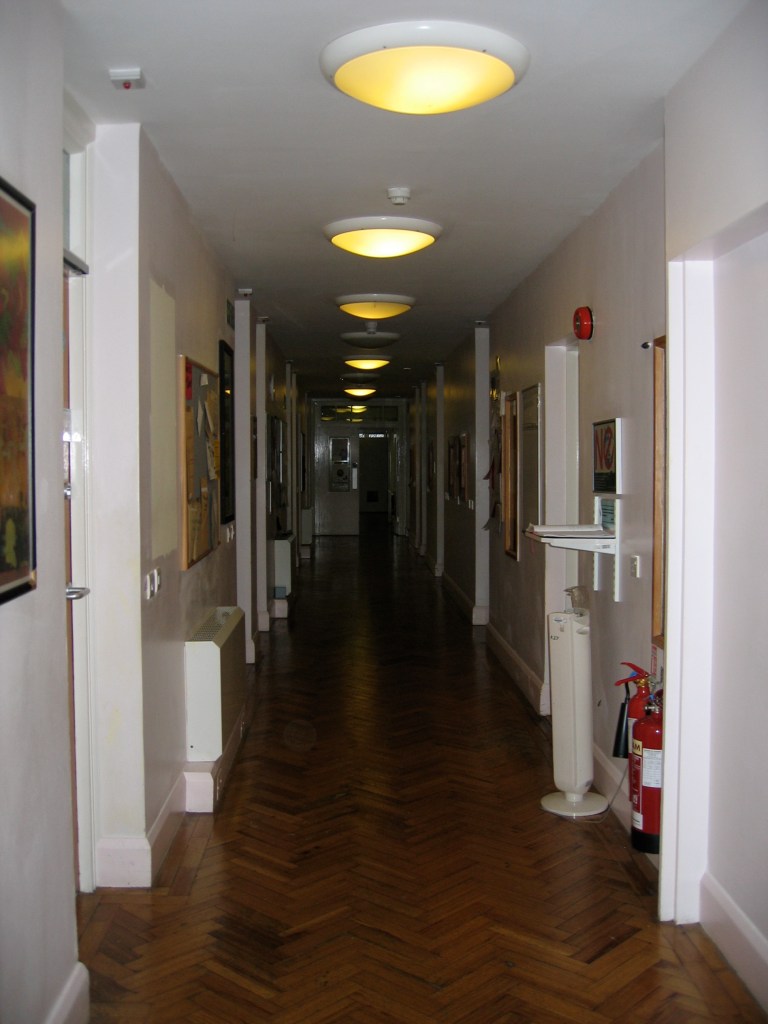
EDS ward – the long corridor

Eventually, though in 2010 my seven sessions were amalgamated under the EDS banner and by about 2012 I had become lead for inpatient psychological therapies on the inpatient ward (not a formal appointment, and perhaps largely by dint of being the last one standing). At this time I also applied successfully for a part time Consultant Psychotherapist post offering Reflective Practice Groups in a forensic setting in another part of London – a job I still have at time of writing. It’s also worth noting that from this point onwards I was working at different grades in the two different NHS posts.

***************

I have written in detail here and here (among other places) about my own journey of understanding in the EDS setting and some of my more clinical conclusions, or rather, let’s say, markers in the hope of new conversations, here. The healthcare politics around the treatment of ‘eating disorder’ were/are constantly shifting and by 2012, if not a little before, the picture was very different from the Service I joined in 2002. A day hospital had opened and the inpatient ward no longer attended directly to the transitional and outpatient care. (I should clarify that in my time there was always an outpatient service – not everything was done by the ward, and of course not every client of the service had inpatient treatment). Bulimia was now treated with adapted outpatient CBT only – although low potassium, the most dangerous physical side effect of practices of purging, could still land one in the general hospital ICU.

The Mental Health Act was now in use as often as not (I no longer have access to the stats, so please take these as broad brush statements, but the direction of travel away from ‘voluntary’ admission was pronounced); naso-gastric force-feeding was now somewhat common on the ward, rather than unheard of; and at about this time a small intensive care bay was developed on the ward, where very severely emaciated patients were treated under theoretically closer observation and in circumstances of greater restriction – a kind of claustrum within the claustrum of the wider (locked) ward. I should also mention that the ward was on the second floor, with no easy access to fresh air – at one point a lift was built, but in my memory almost never worked. The whole building is now destroyed, the ward has moved (still on the second floor, but with better access to the air), and blocks of flats have sprung up on what was hospital land.
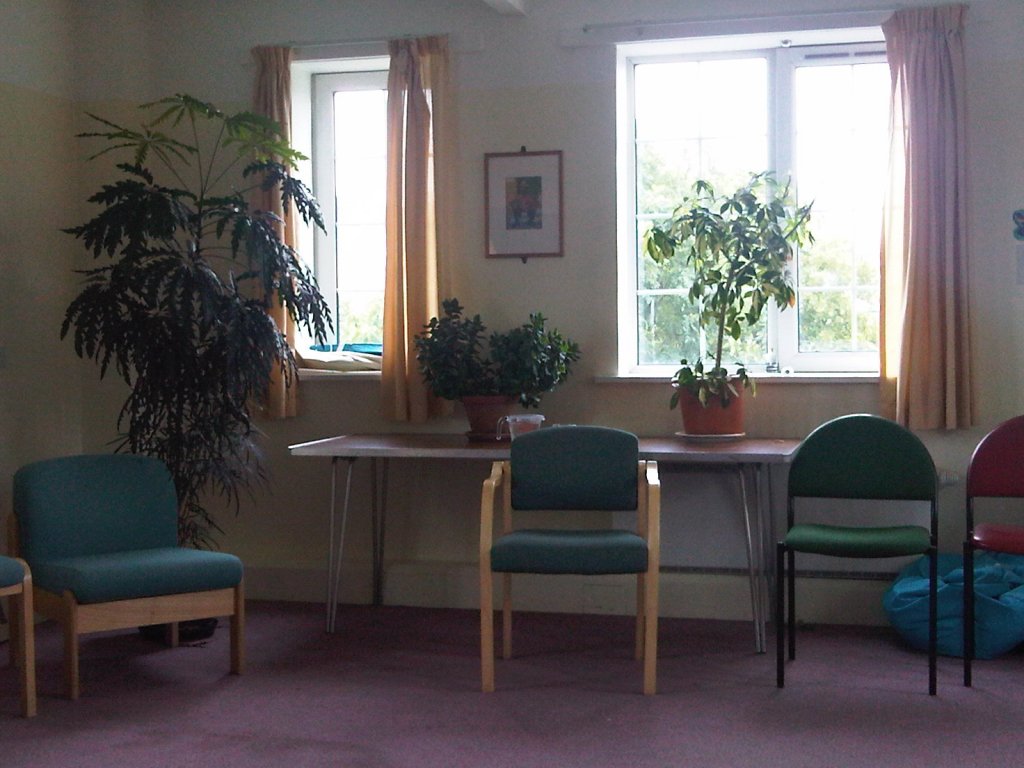
EDS ward – community meeting room

By this time you will already have gathered that the NHS Democratic Therapeutic Communities had closed down. One of the consequences of that kind of cultural vandalism is that a diaspora of survivors, for whom once there was at least the possibility of meaningful and hospitable accommodation within ‘the system’, now were back out in the cold, unpersuadable by the sorts of offers that sprang up in the wake of the passing of the DTCs (for, of course, many who should have been fighting alongside us for the survival of the DTCs, had their eye to the main chance of service development that the moment of their demise had opened up).

Some of these sufferers found their way into these wards (I am not for one second suggesting that this was conscious or intentional on their part! – I am making a psychosocial observation at societal group level) and the ward team’s previously fairly unanimous confidence in the diagnostic categories of eating distress (and certainly mine!) started to break down in the face of complexity and the grievous trauma histories of so many of the patients. This led to sometimes bitter disagreements – over admission criteria, discharge criteria and all points in between.
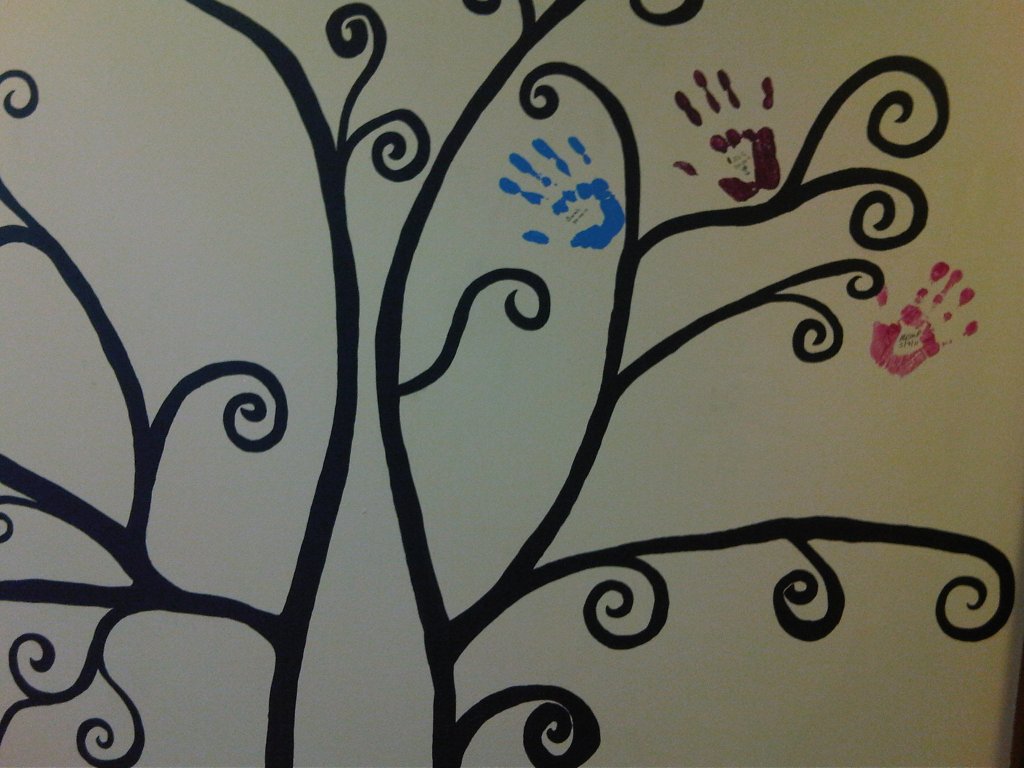
EDS ward – Leavers’ tree, section

It also illuminated a kind of paradox – for it became clear that the ailment for which one was treated on this ward was malnutrition, rather some construct of a psychiatric condition of tending towards malnourished states. Instead of long full recovery treatments with batteries of therapies, the focus was on reversal of the immediately life-threatening aspects of malnutrition and then – well, onwards, and elsewhere, and be gone – except that the duration of those admissions didn’t necessarily get any shorter, and sometimes got much longer…

The paradox I just mentioned lay in the fact that the only evidence-based intervention to assist with malnutrition is to provide nutrition – to ‘re-feed’ – and yet at the same time the other salient reality was that the patients had all sorts of (fundamentally post-traumatic) needs (I am conscious of ventriloquising, but I think the people that I sat with and got to know there would at least broadly agree) that could not be met within the specific frame of ‘treatment for eating disorders’.

For a while, then, there was an attempt to offer hospitality of a kind – psychotherapy, yes, and psychotherapy groups – but also survivor-led community meetings, action research projects, co-writing projects, external consultation from experts from lived experience, and jointly-generated and curated conference poster presentations, community projects such as the therapeutic eating charter (which you can see in its rainbow format on the wall of the now-demolished ward dining room in the image below – I am assuming that this rainbow was also destroyed, but would love to hear otherwise!).
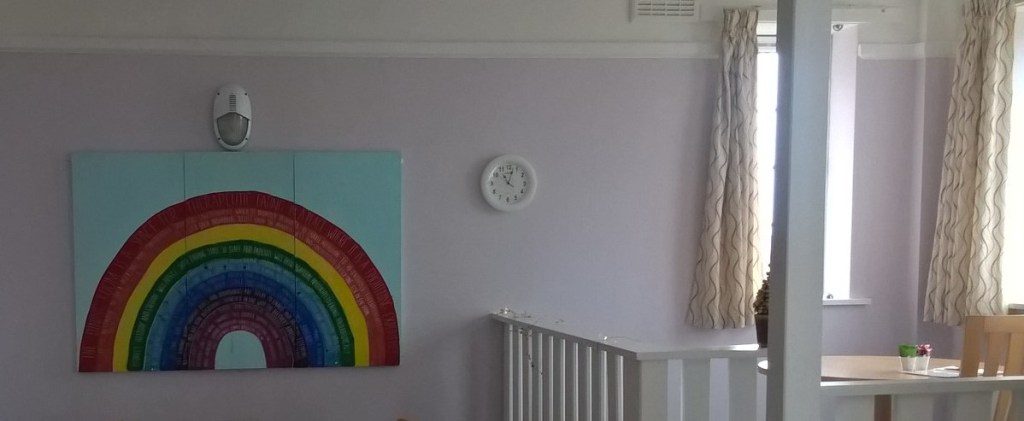
EDS ward, the dining room

Also, by this time, I had trained in Mentalisation Based Treatment (MBT), one of the various ‘three-letter therapies’ lately in vogue. In about 2013/2014 we had the whole multi-disciplinary team trained up in MBT skills to practice, not so much as therapists in the consulting room, but in ‘corridor conversations’ and other ordinary encounters on the ward (and extraordinary ones, in the dining room for example) – in pursuit of the undeniable principle that it is more helpful to ‘mentalise’ the other, to keep the other’s mind in mind, than to fall back on ‘othering’ ‘them’.

***************

Some things work for some people, when it comes to therapy, and the therapeutic milieu – and there’s nothing that works for everyone. The only thing we really really know about talking therapies is that it’s the relationship between therapist and patient what wins it, if anything does win it, and the rest is nuance and fine lines and the particular case and the narcissism of minor difference (as between the protagonists of the competing three-letter therapies, or psychoanalysts versus everyone else).

I know that some people felt immensely helped by this shared, psychosocially and psychodynamically informed milieu approach that for a while we were able to offer and sustain. I also know that the psy therapies are only a small and perhaps an overvalued part of the overall offer in such a setting. I am still haunted, what is more, by those who I got to know so well and so deeply, but who in the end did not survive. And I do not use the word ‘haunted’ lightly.

So this is not the place, and I am not in any position, to make any special pleading that I personally was ‘right’ about anything. I can only adduce one fact with confidence. In 2018, after another long and intensely bitter and debilitating ‘consultation’, and in the face of considerable protest, psychotherapy was cut from the ward – along with the two remaining psychotherapists – in favour of (at the time) a brand new manualised three-letter therapy, CRT or Cognitive Remediation Therapy.

I suspect that we were felt to have become too hospitable – that the length of stay, a most erratic barometer of ‘progress’ in such a setting, but a numerical metric to the spreadsheet-minded, was felt to be increasing, and that psychotherapy and the milieu approach and a flattening of hierarchy were together felt to be ‘encouraging’ patients to ‘settle in’ for the long haul, even (Heaven forfend!) to ‘make themselves too much at home’. And I would be the last to argue for longer stays as such, or to wish even a week of treatment in such a place upon anyone – or perhaps more to the point, to wish even a week, upon anyone at all, of the kind of soul torment that brought people to our door. I also feel fairly sure that the team, and certainly not our senior managers, were no longer united behind the approach, and therefore, all other factors aside, for this reason it was not sustainable.

But such are the eternal dilemmas of (especially ‘specialist’) inpatient treatment in the psychiatric system of care. There is always, as already mentioned, a terrible and terrifying ‘bump down’ from the claustrophobic intensity of inpatient care to the agoraphobic wilderness of outpatient care. It’s also important to keep in mind that inpatient care is ’24-7′, but not in the sense that there is a consistent experience of being cared for.

On the contrary (and leaving aside what may be the terrors of the care offered and received) the inpatient experience is more (I think – again being wary of ventriloquising, but this is what the patients taught me) of the ‘lighthouse beam’ (to borrow a term from one of my supervisors) of care and attunement being upon one momentarily, or for a session, say, but then moving on to someone or something else and leaving one just as much in the dark as if one were not ‘in inpatient care’ at all….

There is also, almost literally, nowhere to go, in terms of that forty year old chimera, ‘care in the community’. We still do not yet understand the full consequences of Austerity Mark One – or the pandemic – let alone the perverse horrors of a Labour government driving Austerity Mark Two.

The old EDS ward – still life with bulldozer

***************

Psychotherapy was out of fashion, then, and out of favour, and EDS psychotherapists still standing by then were very few, but had still to be disposed of. I went through another period of uncertainty while the Citadel decided what to do with me. The interested reader might be intrigued to learn that there is a kind of secret NHS slush fund for paying off employees when the Citadel can’t afford the redundancy payments but can’t risk putting the person through yet another more or less violent redeployment for fear of litigation. I hasten to add that I had no thought of such retaliation. But it’s interesting that I must have looked like I was capable of it, and that it was a thing worth ‘their’ while avoiding.

In the end – eventually – I was relatively peacefully ‘rationally redeployed’ (ie ‘an offer one cannot refuse’), down just one flight of stairs in the same (now bulldozed) building, to an outpatient Complex Needs Service, six sessions a week (down from seven, but whatever!) to practise outpatient Mentalisation Based Treatment (MBT).

There I made, gradually, the best, I think, of my peremptory eviction from the other service, by picking up the facilitation and management of the treatment group for Young Adults (18-25). Over the next seven years I helped to make the Young Adults Project into a service within a service – a model that may now be replicated in other boroughs within that organisation.

The history here, and my own departure, is much more recent and I will accordingly limit myself to two comments. First of all I want to pay awestruck tribute to the truly amazing people who were clients of the Project over those seven years. I was thirty years old before I got my own self anywhere near intensive psychotherapy, and I never took the risks that these brilliant younger people did, in coming into therapy with us.

Secondly, I want (again!) publicly to deplore the fundamental dishonesty of the euphemism of ‘Complex Needs’ within the term ‘Complex Needs Service’ – especially when, in pretty much all the conversations about the pathway that take place in boardrooms inside the Citadel, the toxic attribution of ‘personality disorder’ – and its even more toxic acronym ‘PD’ – remain the main terms in circulation.

You can’t have an ‘evidence-based’ treatment for a non-existent illness entity. Too many people have died of the attribution, the stigma, the impact of the discourse around it on the way services think about treatment – in my direct experience of this last quarter century. The system of care needs to take the bulldozers to that whole edifice, and all of the language and discourse around it, and build a new one from scratch. We are all human and (therefore) we are all flawed. The diagnostic taxonomy of the fiction of ‘personality pathology’ is a haunted house of horrors. We can’t just put up a new sign over the door, and carry on as if ‘nothing happened here’.

***************

This piece has ended up much more akin to a book than a blog. I will therefore make one more reference, and then leave you with a thought. Thank you again, for lending me your ear.

As I was approaching the finishing line of this piece, which was written in fits and starts over four or five weeks, I became aware of a very excellent piece written by someone I know in a different setting, that was published just a week ago. Its called “The ‘Impossibility’ of working in the current NHS: sacrifice to a primitive god” – which is a fabulous title for a paper – and I absolutely commend it to you, I don’t want to say that my blog here is exactly a companion piece to my colleague’s article, but there are some clear resonances, and she covers the period 2008-2018, which is precisely the period bookmarked for me by the two violent redeployment processes that I have here described.

As for myself, I give myself over now to the judgment of my readers, as I promised to begin with. My reflection, now that I have written what I have written, is that it’s not only that I await your judgement. I realise that in some profound sense I long for your forgiveness.

This is complicated, and I’m not presuming to ask for it, still less to expect it. And you will appreciate that I don’t mean your forgiveness for having taken more than 5500 words to say all this – I realise of course that such self-indulgence can’t be allowed to pass!

No, it’s something different, something deeper and murkier – something uncanny, perhaps. And it’s not the ‘forgiveness of the authorities’ – to borrow a line from John le Carre’s ‘Smiley’s People’ – I’ve been quite a nuisance to you-the-authorities at times (perhaps not often enough), but so have you been far more than a nuisance to others (your nuisance to me, I count as of no moment, not in the scheme of things).

No. I think it’s the forgiveness of the patients, the survivors, and those that did not survive, that I long for – but cannot venture to plead for, since I have no right to such forgiveness, and no right even to ask for it. I can only offer reparation.

Perhaps this piece of writing – and its being published here in the agora – may stand as some very small part of such an offering.
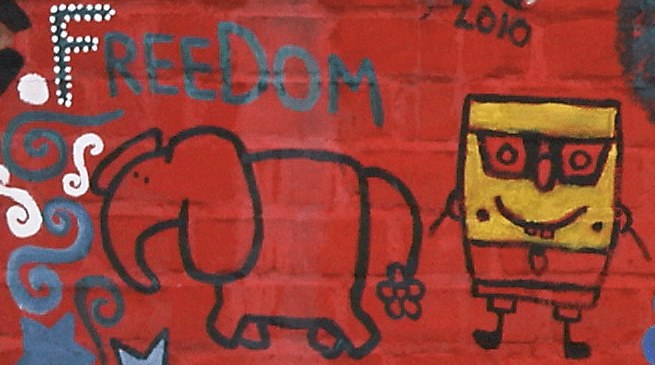
EDS ward – Mural section (‘smoking balcony’)

Afternote: I have tried to be careful, and have selected out images of particular discrete artworks, or cropped out specific identifiers, but there is definitely some ‘patient’-generated artwork visible in some of the images I have used, and possibly one or two of the photographs from the EDS ward were also taken by patients (and shared with me (in 2011, as part of a ‘co-production’ project, I think)).

I took some of the photos (definitely of the DTC patio, and the bulldozer, and the title image), but can’t now be sure, as to the other images, which are which. My records, I’m afraid, now fail me as badly as my memory. If anyone sees these images and can identify themselves – and would like to let me know, and as an option to request a named acknowledgement – I will be very happy to edit the blog accordingly.

Ida smiles

I am reblogging this poem of mine from the Atrium WordPress site where it was published today – many thanks to the Atrium team – Claire Walker and Holly Magill – for believing in this poem and giving it a platform. A second poem of mine is appearing via Atrium next month!

To go to the Atrium site to view the poem, please click on the title hyperlink within the box above.

‘Lifestyle choices’ revisited

“…the caterpillar and fly/Feed on the Mystery/And it bears the fruit of deceit/Ruddy and sweet to eat…” (The Human Abstract – William Blake)

How do we solve a problem like Suella Braverman? The UK Home Secretary has been on a certain ‘social media’ platform, positioning herself for the Conservative Party leadership election and doing her bit to lean on the King’s Speech coming up on Tuesday (which will announce a legislative agenda this government does not have enough time left to fulfill before a General Election next year). She has said, [and I vomit quote][especially vomit-comment-worthy sections in bold, because that’s as much as I can bear to have to do with them for now]:

“The British people are compassionate. We will always support those who are genuinely homeless. But we cannot allow our streets to be taken over by rows of tents occupied by people, many of them from abroad, living on the streets as a lifestyle choice. Unless we step in now to stop this, British cities will go the way of places in the US like San Francisco and Los Angeles, where weak policies have led to an explosion of crime, drug-taking, and squalor. Nobody in Britain should be living in a tent on our streets. There are options for people who don’t want to be sleeping rough, and the government is working with local authorities to strengthen wraparound support including treatment for those with drug and alcohol addiction. What I want to stop, and what the law-abiding majority wants us to stop, is those who cause nuisance and distress to other people by pitching tents in public spaces, aggressively begging, stealing, taking drugs, littering, and blighting our communities.”

Let me first of all say that really there is nothing to be done with the Home Secretary but count down the days to her inevitable eviction from office, and to see if she can then tell the difference between a lifestyle choice and a survival strategy. If we fixate on her words, on the world view they express, and the attack on the agora that they represent, as being her words – the abhorrent verbal excreta of a particular populist politician, no more, no less – we are seduced into imagining that the words will go away when she goes away – or worse still, that the words will go away if we stick our fingers in our ears and wish for them to stop.

No, the thing to do is to understand this rather cowardly woman (so much for nominative determinism!) to be spokesperson for an in-group as it wages continual war – across a battlefront running through society, as Foucault put it in Society Must Be Defended – upon an out-group which it displaced in order to gain power and which it needs to keep subjugated so that it retains power. The main weapon in the in-group’s armoury, now that one can no longer be executed in the UK for treason, heresy, or being an ‘enemy of the common weal’, is the deceptively simple ‘biopolitical’ practice (Foucault again) of projecting responsibility for the original displacement and the ongoing state of unsettledness from the perpetrator (the in-group who did the un-housing in the first place) into the victim (the displaced out-group, now constructed as having made lifestyle choices to be homeless, workless or Stateless).

Conscious that referencing Michel Foucault and Karl Marx and disrespecting the incumbent of a high office of State in this country may get me prosecuted for undermining the institutions of said State under other proposals to redefine ‘extremism’ pre-leaked to be announced by the king at the opening of Parliament tomorrow, I must, nothing daunted, go on to remind us all that it was old Karl himself who first or most famously pointed out that (in our language now) the in-group first of all evicted the proletariat from the land (by means of Enclosures of the commons, and other such devices) and then criminalised (via the early Poor Laws) having no fixed abode or gainful employment. If you were caught three times on the road without proof of address or work and no evidence of severe physical disability, you were not (pace La Suella) ‘genuinely homeless’ and could be executed for being a ‘sturdy vagabond’ with past form.

Successive bouts of legislation have compounded and reinforced this original offence, including the 1824 Vagrancy Act which is mentioned in the newspaper article hyperlink above, due to be repealed. The Braverman attacco di vomito is simply one, scarcely even egregious, link in a very long chain of counter-revolutionary class warfare of the kind in which the land-owning culture-carrying in-group in this country has been specialising all the way back to the early Middle Ages – as quintessentially English, if you will, as warm beer, or religious bigotry, or capitalist/Imperialist rapacity, or race hatred, or air pollution, or a game of cricket on a village green.

Yes, Officer, I will come quietly…

My barrelmate Chris Scanlon and I have been exploring this territory – and (spoiler alert!) exploding the toxic mythology that there might be such a psychosocial phenomenon as ‘ungenuine’ homelessness – for two decades now. La Suella is very welcome to a complimentary copy of our book published last year, in which we wrote:

“We locate ‘the problem of homelessness’ in the continuing inability, of this society in which we live and of those systems of care in which we have been working, to recognise and to integrate, into its responses and interventions to this problem, both the sociological fact of dispossession or not having a ‘fixed abode’ and the psychological experience of feeling disrespected or of not feeling welcomed or accommodated. Our concern is therefore with what it might be like to not have a place to belong – with the experience and the phenomenology of ‘vagabondage’ – of what it might feel like to have nowhere to go and no-one to turn to in order to feel ordinarily safe (or safe enough) or to find refuge or asylum.”

There is much more to be said, and much that has already been said. I suppose we might find it at least vaguely heartening that even the odd Conservative Minister (and o my! are they not an odd lot, or what?) has baulked at entirely going along with Yella Suella on the ‘lifestyle choice’ point. But next time you hear something like this, be sure to be quite clear, that what you are hearing is the sound of someone who has built their pile on the bones of little people, calling some other little people ‘vagabonds’, to license and sanction some further bone-crushing and pile-building.

And know also, that although this has been going on for half a millennium and more, nonetheless, somewhere, sometime, it will reach its limit – and then a day of dreadful reckoning may be anticipated.

Mau-Mau, colonial violence and restorative justice: what Charlie said next?

The King of these little islands revisits the scene of some of the many crimes of Empire today, when he returns to Kenya for his first ‘State’ visit to a Commonwealth country. The Kenya Human Rights Commission has called upon him “on behalf of the British government, to issue an unconditional and unequivocal public apology (as opposed to the very cautious, self-preserving and protective statements of regrets) for the brutal and inhuman treatment inflicted on Kenyan citizens”, especially but not exclusively during the so-called ‘Emergency’ period from 1952 to 1960, when Kenyan people were fighting to gain their independence from the British Empire – a fight that concluded in December 1963.

The British government (in the unlikely person of William Hague) admitted back in 2013 to much of the torture and abuse – but ‘without prejudice’, and only after the Foreign and Commonwealth Office had vowed to fight to the death the class action brought against it, led by Wambugu Wa Nyingi, Paulo Muoka Nzili and Jane Muthoni Mara, parts of whose testimony you can find here.

It has been widely trailed that some ‘diplomatic’ form of words is making its mangled way through the royal intestinal system, acknowledging painful history in some form or other – and I must immediately say that it is not for this White barrelman – accessory after these facts as I am – to pronounce as to how these words might be received by those to whom they will be addressed.

But a Cynic can dream (it’s only a cynic who can’t!), and it’s been on my mind a while to imagine what Charles might say, if – well, probably if he were other than who he is – but let’s give him the dubious benefit of some very considerable doubt, and imagine a man wrestling nightly with Angels, and scribbling in secret ink beneath the royal duvet, plotting to elude the scrutiny of his minders…..

“Ladies and gentlemen, my distinguished and honorable hosts, I am most humbly grateful to you for what in all the circumstances is your most extraordinarily gracious invitation to me to join you here today, and for the warmth and generosity of your welcome.

My heart is full, for I have vividly before my eyes the scenes seventy-one years ago, when my beloved mother was staying in this land under perhaps very different circumstances, when news reached her of the death of her father – and this is the first time I have ventured upon such a journey since her own death.

However, although I am my mother’s son and the ceremonial head of State of the Commonwealth, I speak both in that role and also as a man, as a fellow human being, when I say to you today that my heart is heavy for a greater and more solemn reason.

I am come before you both with the ceremony of State and with personal humility, to make apology, reparation and restoration, and to ask, how reparation and restoration, having been begun, might be continued, until justice has been seen to be done.

For I and my people have wronged you and your people – we continue, in both intent and effect, to wrong you – with our public minimising and our knowing private racism and our continuing economic warfare – and it is entirely clear that we must wrong you no more.

In case anything thus far is not clear: your Human Rights Commission has asked that I, on behalf of the British Government, issue, and I quote their words: “an unconditional and unequivocal public apology (as opposed to the very cautious, self-preserving and protective statements of regrets) for the brutal and inhuman treatment inflicted on Kenyan citizens”.

I do apologise: unconditionally, unequivocally, wholeheartedly. More: I hang my head – personally as well as ceremonially – in shame.

My people came among you long ago, and we were beside ourselves with greed and bloodlust and possessed of an utterly misplaced religiosity, moral fervour and blind self-righteousness. We imagined ourselves super-humans, and we constructed you as sub-humans. We destroyed your way of life with the rapaciously calculated imposition of our own local land and property laws; we set you against each other; we exploited your land and extracted its treasures; and when you mobilised yourselves in protest and uprising, we were brutal and sadistic and devoid of ruth or shame in the manner in which we unhoused and abused and tortured and slaughtered you in order to subjugate you anew to our power.

You have, here and now, this my apology. I hope you may find that it means something to you, and that you may speak freely to let me know what it might mean. For it is not for me to say what it should mean. It is long past time for the likes of me to give up the evil habit of dictating meaning to others.

But now, if I may, I have a follow-up question, which I shall ask, and then stop speaking – for my next words will depend upon what answer you may give. Here is my question:

“What now, what next? What would be most helpful? What would you ask of me – of us?””

Well. It’s five hours later on. Let’s see what he did actually say…(I have marked in bold the bits where an active mode or a possessive article or a less ambinuous possessive article than ‘we’, or a spot of detail about who did what to whom would have helped, but was missing)

“….However, we must also acknowledge the most painful times of our long and complex relationship.

The wrongdoings of the past are a cause of the greatest sorrow and the deepest regret.

There were abhorrent and unjustifiable acts of violence committed against Kenyans as they waged, as you said at the United Nations, a painful struggle for independence and sovereignty – and for that, there can be no excuse.

In coming back to Kenya, it matters greatly to me that I should deepen my own understanding of these wrongs, and that I meet some of those whose lives and communities were so grievously affected.

None of this can change the past. But by addressing our history with honesty and openness we can, perhaps, demonstrate the strength of our friendship today.

And, in so doing, we can, I hope, continue to build an ever-closer bond for the years ahead.”

So there it was. As I already mentioned, it’s not for me to say how that should have been received. But you can see that The Firm lawyered up, because the ‘wrongdoings’ are rendered in the passive voice. Nobody can tell from the speech what the wrongdoings were; who did them; who regrets that they were done; or who should not be looking to make excuses. The only perpetrator named is ‘the past’ – as in: ‘the wrongdoings of the past’.

The speech has already been marked as ‘a miss‘. This was a non-apology, a finely tuned piece of Doublespeak dressed up as an olive branch. It may even be a welcome branch, and/or one worth grasping. Perhaps it was enhanced in private, off-stage. But it was a long way from being able to stand as a piece of restorative practice in the agora.

Omphalos

It’s been quite a while since I posted here. This is not because there’s been nothing to rage about – it may possibly have been because there’s too much. I have yet to find words for Bibby Stockholm syndrome, to pick but one issue out of the jar … but I have been writing a poem, and thought I would share it here.

Diogenists amongst you will likely spot the poem’s oblique reference to that old-school barrelman, because a pivotal moment in his story comes when he pages the oracle at Delphi and gets the puzzling exhortation to go forth and do what he thought he’d already got done for: namely, to ‘deface the currency’.

For all we know today, the Pythoness (the priestess of the temple, who channelled the word of Apollo) may have been looking backwards into his story rather than forwards – or the priests who used to scribe and reformulate her words may have misheard – but Diogenes takes it that he must deface the political currency, and thus a legend is born …

This poem plays on the fact that the area of Paris known as Montparnasse, where a famous and beautiful cemetery is located, is named for Mount Parnassus in Greece, upon the slopes of which the temple of Apollo at Delphi was built. The Greek peoples of those times believed that the site of the temple was the centre of the world as marked by Zeus and that the stone (‘omphalos’) that he placed there was the world’s belly-button – and that this is why the Word of Apollo could be heard so clearly.

This particular Barrelman has never yet visited Delphi, but I have more than once had the good fortune to be able to wander around Montparnasse – and so here is my poem, and I hope you enjoy it:

Omphalos

I.

By the Seine we are secret lovers
let suddenly loose. We float lazily
about the citadel, fey and febrile
as the river’s grey surge and swell;
we sip coffee at Les Deux Magots, spy
something magical

glittering in the eyes of each passer-by,
drift hazily down the Rue Mouffetard
towards the catacombs, and all the while
I dare not forgo the feral heat
of your hand in my hand – we are Héloïse
and Abelard – we are Bogart and Bacall –

we are Jean-Paul and Simone –
no doom may daunt us, no death outrun us.
At Montparnasse cemetery, in the orange gleam
of a faltering mid-September sun, we flit between
the tombs and ossuaries like zephyrs,
fleet and phantasmagorical,

whispering with the shades of Baudelaire
and Beckett, sifting the leavings of grass and gravel,
lifting dust and petals from the graves. Feeling our way
to the far wall, we place two twenty-centime pieces
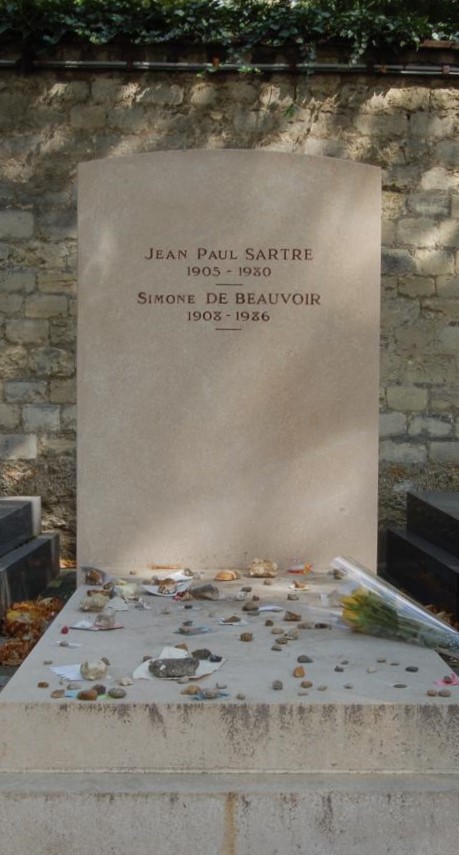
on the bed that Sartre and de Beauvoir share –
wishing on a morning’s quiet miracle.

II.

Tracing tired steps
back towards the Latin Quarter,
we chance upon a backstreet stairway, a door
stood ajar, warm air rising from a basement bar,
a saxophone dancing, splintering the stillness
of the midnight in soaring lyrical

frenzy, and I conjure an image
of the Pythia at Delphi, the cadences
of her vocalisations like trailing vines
snaking between the cracked and crooked
ancients of the olive groves, her wailing
words like strings of coracles

bobbling, riding torrents of breath,
cascading down Mount Parnassus
towards the banks of the Pleistos – writhing
in delirious inspiration, veiled in flame,
wreathed in the fumes of volcanic vents –
her serpentine divinations, allegorical

and tenebrous, woven into parables
for philosophers to parse, or princes to puzzle –
a sulphurous jazz priestess of the high passes,
a bebop Pythoness jiving at the world’s navel,
improvising the cryptic Apollonian
song-lines of her oracle.

The image of the tomb of Sartre and De Beauvoir was taken by Angela Signorastri. The image of the temple ruins at Delphi is by Luarvik/Wikimedia, reused under creative commons licence: https://commons.wikimedia.org/wiki/File:The_Temple_of_Apollo_at_De: lphi.jpg

Monarchy in the UK: how White power does its thing

“Master, you eated me when I was meat, and now you must pick me when I am bone” (Anonymous Canadian slave, 18th century, reported in Patterson 1982, p. 338)

It was sobering to come across this very recent news item concerning a guest at a reception at Buckingham Palace being racially abused by a ‘Lady of the king’s household’, one Sarah Hussey, a godmother to William Windsor, the king’s son; and as it goes the widow of old Marmaduke – ever a name to conjure with – who used to be Chair of the British Broadcasting Corporation, way back and long before I built me a barrel to barf in.

Now, I don’t want to pile in upon, brandish my stick at or in any other wise throw  self-righteous stones at Lady Sarah, properly vertiginous as has been her fall. She definitely doesn’t get a free pass, but I am solemnly conscious that there are people much closer to me than her who might also not have shone on such an occasion. The thing to do, I believe, is not to locate racism in the even-more-privileged other, but to work all the harder to uproot it in oneself.

Ngozi Fulani, the founder of Sistah Space, who was the person abused, has indeed very aptly pointed out that what is clearly needed over at the palace is some cultural competency training, rather than (yet more) scapegoating – and so there we will leave the matter – except to say that here is a link to the Sistah Space website if you would like to find out how to support their very important work.

I begin with the incident at the palace, though, not for what might be inferred about any particular person who is part of the failing institution that is monarchy in the UK, but rather for what might be said about the institution itself – and about the White power that it propagates.

The story particularly caught my eye because, now that we have us a ‘Charles III’ on the throne of this country, my mind has kept going back to what was wrought by his forebear Charles II (and that ‘merrie monarch’’s brother the Duke of York, later James II). I then wonder what might be said about the period of world history that runs (on an admittedly parochial view!) between those two right Charlies: from the Restoration of the Monarchy (and the accession of Charles II to the throne of England, Scotland and Wales) in May 1660, up to and beyond the succession of Charles III (to the throne of the United Kingdom, and of those other ‘Commonwealth’ countries that still for various reasons bow the knee) this last September.

***************

Charles Stuart, exiled in Europe after being defeated by Cromwell in 1651 – and via many a jolly jape (dressing up as a servant, can you imagine?) as he escaped England and the fate that befell his father Charles I – lived off of the hospitality and generosity of his fellow monarchs for the rest of that decade, nursing his grievance and plotting his revenge, in France and then in Spain.

Perhaps part of the whole appeal of kingship, if you are professionally speaking a scion of a royal family between gigs, is first of all payback and, immediately following, nest-feathering. Certainly the very second thing that happened after Charles claimed back his father’s throne (and had those responsible for his father’s execution hung, drawn and quartered) was the Chartering in 1660 of the Royal Company of Adventurers Trading into Africa, afterwards known as the Royal African Company. Adventurers, indeed! James Stuart, Duke of York, was the company’s primary shareholder. Initially it traded in Ghanaian gold; but it was also an official instrument of State policy of taking control of the slave trade and excluding other European powers, at that time especially the Dutch, from its lucrative profits.

Bear in mind that ‘the scramble for Africa’ of mid to late Victorian times is yet two centuries into the future. The Portuguese had started taking sub-Saharan African people into slavery in the second half of the fifteenth century (armed with the blessing of, and a guarantee of immunity issued by, Pope Nicholas V, who decreed that any and all “Saracens and pagans and any other unbelievers and enemies of Christ wherever they may be” might be reduced to ‘perpetual servitude’). But by the 1660s, the presence in the African continent of White European invaders is still limited to a hotch-potch of coastal forts and outposts, regularly changing hands as the next particular Power-of-the-day would come along to claim and gain the ascendancy.

The English muscled their way into the slave trade in the second half of the sixteenth century, after Henry VIII’s excommunication in 1538 had rendered irrelevant the continuing Papal protection of the Portuguese; and by the first quarter of the seventeenth century the demand for unpaid labour in the sugar plantations of Britain’s new Caribbean colonies had generated a sustainable ‘market’ for slaves. However, it was only when the Stuart family got in on the act that the violence and plunder began to escalate.

Here, if you don’t believe me, is the Company’s coat of arms, which rather says it all. Its Latin motto, incidentally, translates as “By royal patronage commerce flourishes, by commerce the realm”; or, to put more directly, “we expect a free pass, for we are only in it for love of country, and there’s gain for you all and plenty, if you turn a blind eye, o citizens of Thebes”. That there were no illusions, about who authorised this trade and who were the primary stakeholders, is evidenced by a contemporaneous reference to the ‘Barbary Company’ in Samuel Pepys’ diary.

From 1663 the Royal African Company’s renewed charter not only specified that slaves were part of its stock in trade but, according to the custom of those days, it explicitly claimed monopoly in that trade. By the 1670s the Stuarts had formalised the ‘triangular’ slave trade. Ships loaded with goods for trade sailed from England to Africa; captured and abducted slaves were transported to the West Indies (this was the ‘middle passage’); and plantation produce (more plunder) was then shipped to England – thus generating yet more wealth and profit, and new goods a-plenty to be traded abroad.

The Stuarts in the end didn’t profit quite as much as they no doubt had hoped, as that piratical royal ‘Company of Adventurers’ were in turn displaced by the Glorious Revolution of 1688. The slave trade as dominated by the English/the British in fact only really boomed after the Royal Family relinquished its monopoly in 1689. Nonetheless, between 1672 and 1731 the Royal African Company transported more than 187,000 slaves to the Americas (or towards the Americas: nearly 40,000 of these died en route).

The Company thereby violently displaced more human beings than any other single entity in the whole abominable history of the Transatlantic slave trade. Many of those 5,000-yearly people transported in the 1680s were branded on the face with the letters DoY (for Duke of York) or on the chest with the initials of the Company (RAC). The wealth generated and plundered by the triangular slave trade that the Stuarts inaugurated would kick-start the Agricultural and Industrial Revolutions and power the might of British imperialism into the nineteenth century and beyond.

***************

This prolonged and terrible violence is a story that cannot be told often enough. It will be familiar to many if not most readers. However, I must also acknowledge that anyone with access to Google and a smattering of British history for background and context could put together a similar account – and I must also go no further without owning my own positionality as a White man and property-owner who is beneficiary if not accessory after the fact of this colossal criminality.

As I have already commented, neither is it open to me to attempt to project racism into the Other: it is mine for the owning. Anti-racism begins at home. So I must say now why this story needs this, my particular re-telling. The thing I want to do here is look at the history specifically as a history of White power and Whiteness: how it operates; how it propagates and reproduces itself.

Fear and disparagement or demonisation of the Other is as ancient an aspect of human history as the first forming of humans into social groupings. However, racism is a distinctively modern strain of ideology. The concept of ‘race’ came into being among the White colonial powers of Europe in the second half of the seventeenth century, at around the time of the Enlightenment – and the reign of the Stuarts. Racism launches and lands as ideology as part of the social, economic and political and philosophical processes that also birthed secularism and liberalism, industrialism and imperialism.

The historical moment in which racism, in what would become the modern sense (Audre Lorde defined racism as “the belief in the inherent superiority of one race over all others and thereby the right to dominance” (2007, p. 45)), is first enshrined in law arrives with the Barbados Slave Code of 1661 (the year after the Restoration). This piece of legislation, formally known as ‘An Act for the better ordering and governing of Negroes’, came into being because the White planters felt the need to scaffold their violent exploitation of their enslaved workforce with a legal framework. It was this document, not so much ruthless as pre-ruth in its conception, that established the legal status of slaves as ‘chattel’ of their masters (as the great Angela Davis noted, constructed as “a herd of subhuman labor units” (1981, p. 12)).

In order to profit to such an extent from treating human beings like cattle, it became ‘necessary’ to establish in law an equation with cattle as the status of certain groupings of people. Racism was the ideological rock out of which this legal dungeon was hewn. It set a grim and gruesome precedent, template and augury for the legal codification of the violence of slavery in multiple other jurisdictions, including the American colonies.

By means of and consequent upon its spurious clustering of all Black bodies as ‘Negro’ and its outright denial of their humanity, the colonists, traders and slavers of multiple European nationalities came to construct themselves, in antithesis, as White and human:

“The Atlantic slave trade had taken Africans from numerous and widely differing cultures and ethnic groups and defined them en masse as ‘negroes’. Now the pioneers of English plantation slavery … ushered all Europeans, irrespective of their ethnic or social backgrounds, into the new category of ‘white’; a term that had to be explained to newly arriving Europeans who were unfamiliar with the working of the new slave society” (Olusoga 2016, p. 71)

‘Whiteness’ and ‘human-ness’ became a subliminal equation built into the molecular structure of modernity. WEB Du Bois famously observed that “[t]he discovery of personal whiteness among the world’s peoples is a very modern thing” (1903, p. 227). The emergence of skin colour as the imaginary determinant of identity and worth and the construction of Black-ness as equivalent to dangerousness, worthlessness and Other-ness (an inferior, ‘sub-human’ Other-ness) has led, among other disastrous consequences, to the emergence of a (mostly but not always) subliminally-held and (perpetually) self-reinforcing belief system built around the assumption of the ‘good’ of Whiteness.

The ideology of racism emerges out of slavery, but slavery pre-existed racism for millennia. Black people were not exposed to explicitly ‘racial’ prejudice until the British planters in the Caribbean required ideological justification for the slave trade and the plantation system it serviced and sustained. The construct of ‘race’ is the ideological creation of White people and Whiteness is an offshoot of ‘race’. Emergent white European capitalism and imperialism (and the profits to be made from sugar, cotton and tobacco if labour costs were minimised) begat the Atlantic slave trade; the slave trade (gradually) begat ‘race’; and ‘race’ begat ‘Whiteness’, which Guilaine Kinouani defines as “the production and reproduction of the dominance, and privileges of people racialized as White” (2019, p. 62)

Racism as an ideology is therefore not alien to, or outside of, or some aberrant offshoot of the emergence of modernity in the Global North: it is foundational and central to that historical process. Hiding in plain view amid the outpourings of hostility towards racially minoritized peoples is the elevation and idealisation of Whiteness and the White body, of White culture and aesthetics, dressed up as the ‘natural order of things’. The ‘bleaching’ or ‘White-washing’ – both representationally and conceptually – of the Brown bodies of both the Ancient Greeks and the historical Jesus and his disciples offers one example of how discourses and aesthetics of Whiteness continue to dominate thought and perception and practice in the Global North. Indeed, Orlando Patterson has chillingly pointed out that the very idea and ideal of ‘freedom’, so exalted and beloved in the West, emerged

“as a necessary consequence of the degradation of slavery and the effort to negate it. The first men and women to struggle for freedom … were freedmen. And without slavery there would have been no freedmen” (1982, p. 342).

***************

So, let’s ask: what is it that White people need, in order that Whiteness may continue to be propagated? The answer, my friend, is not so much ‘companies of adventurers’, though there have been plenty of those. What White people need is institutions: institutions steeped in Whiteness, dedicated to reproducing themselves, having survival as their primary task. The monarchy of this no-longer-really-very-United Kingdom is but one example of this phenomenon.

Every so often a sudden, fleeting cloud of consciousness scuds across the white-walled face of that institution. ‘Hang on a second’, the cloud seems to whisper, as – just for example – happens when a local charity is rewarded for its work with a reception at the palace: ‘isn’t it somehow our task to stop this sort of thing happening?’

Perhaps this fragment of awareness is what possessed Sarah Hussey to act into her given role in such disinhibited fashion the other evening. But it’s only by seeing that her words were not egregious in relation to their context that the institution she represents can be seen in a clear light: not as harmless, decorative, ossified, irrelevant, but rather as living and breathing and propagating, beating out its ancient and deadly rhythms with a steady hand and a constant pulse.

It won’t do to simply squeeze the zit, cover up the traces with a dab of foundation, carry on as per usual. It’s the internal toxins that need draining and cleansing and healing.

Acknowledgements

Much of the line of thought in this blog and some of the forms of words derive from my work with Chris Scanlon and in particular from Chapter Eight of our book together that came out earlier this year (Scanlon and Adlam 2022). I no longer know where my thought ends and Chris’s thought begins and I find that this is an experience to cherish rather than to worry about. But thank you, Chris!

Many thanks also to Leslie Brissett, whose conference presentation earlier this year caused something to ‘click’ inside me about Whiteness, and who put me on the trail of that old villain and war criminal, Pope Nicholas V.

References

Davis, A.Y. (1981) Women, race and class. Reprinted 2019. London: Penguin Modern Classics.

Du Bois, W.E.B. (1903) The souls of Black folk; with ‘The talented tenth’ and ‘The souls of white folk’. Reprinted 2018. London: Penguin Classics.

Kinouani, G. (2019) ‘Difference, whiteness and the group analytic matrix: an integrated formulation’. Group Analysis 53(1), pp. 60-74.

Lorde, A. (1978) ‘Scratching the surface: some notes on barriers to women and loving’, in Lorde, A. and Boreano, N. (eds) Sister Outsider: Essays and speeches by Audre Lorde. Berkeley: Crossing Press, pp. 45-52.

Olusoga, D. (2016) Black and British: A forgotten history. London: Pan Macmillan.

Patterson, O. (1982) Slavery and social death: A comparative study. Reprinted 2018. Cambridge, MA: Harvard University Press.

Scanlon, C. and Adlam, J. (2022) Psycho-social explorations of trauma, exclusion and violence: Un-housed minds and inhospitable environments. London: Routledge.

Down by the river – the death of Oladeji Omishore

“…when a white man faces a black man, especially if the black man is helpless, terrible things are revealed” – James Baldwin ([1963] 2017, p. 51)

 “The disproportionality in the use of force against Black people adds to the irrefutable evidence of structural racism embedded in policing practices” – Deborah Coles, Director of INQUEST

“Any death involving a BAME victim who died following the use of force has the capacity to provoke community disquiet leading to a lack of public confidence and trust in the justice system. This can be exacerbated if people are not seen to be held to account, or if the misconduct process is opaque” – Angiolini Report (2017, p. 15)

“Were they afraid of me? Was it to control and subdue, as opposed to treat and help? Was it a decision rooted in fear of the ‘large Black man’?” – David Harewood (2021, pp. 194-195)

One sunny Saturday morning last June, down by Chelsea Bridge in central London, a Black man named Oladeji Omishore, known as Deji, was ‘Tasered’ by two policemen.

A report in the Guardian said that the Metropolitan Police stated that “they had challenged a man on Chelsea Bridge and discharged a stun gun but that “did not enable the officers to safely detain him”. The man, in his early 40s, “subsequently entered the river”, police said, ”and was rescued by the RNLI, which took him to hospital”. He died the next day (Sunday 5 June 2022).

The verb ‘to Taser’ obscures, no doubt for purposes of linguistic hygiene, the fact that a ‘less-lethal’ weapon has been fired at an innocent citizen. A ‘taser’ (says Wikipedia) is “an electroshock weapon used to incapacitate people allowing them to be approached and handled in an unresisting and thus safe manner…It fires two small barbed darts intended to puncture the skin and remain attached to the target, at 55 m/s (120 mph; 200 km/h)…Tasers are marketed as less-lethal, since the possibility of serious injury or death exists whenever the weapon is deployed.”

There is plentiful evidence that these weapons are (a) deployed ‘conservatively’ by police to reduce the possibility of police injury and (b) deployed discriminatorily, in that racism as well as stigma around mental ill-health determines who gets assaulted with these weapons and who does not. If you are a Black man presenting erratically in a public place you are very greatly more likely to be assaulted with ‘less-lethal’ electric shock by a policeman than I am as a White man having myself a bad morning. I have written elsewhere about the long grim history of torture, humiliation and death inflicted upon Black people by White people under a racist flag.

The details of police actions that led to Deji’s death are the subject of an investigation by the Independent Office for Police Conduct (IOPC). The bereaved family are trying to raise funds to institute judicial review of this inquiry. Many of the facts in the story have yet to come to light and I may return to this theme once more has been published.

My purpose in writing briefly on this story today is first of all to try to boost the Omishore family’s crowdfunding campaign, which has until Tuesday at noon to meet its £10,000 target. Click on that hyperlink in the preceding sentence, read what the family have to say and pledge most generously!

Secondly, I want to urge that White people need to stand up and fund these kinds of campaigns if the White in-group is ever going to be effectively held to account for its (our!) brutal treatment of the Black out-group. It’s as simple as that. In my book with Chris Scanlon we observe that

“the in-group does not give up power, although it is adept at appearing to do so. It relies heavily upon “the patience and forbearance of the poor” (James, 1938, p. 299). We the authors are sufficiently implicated in its manoeuvring to know that it will not go against its own prime functioning – which, as we have argued throughout this book, is to hold onto power by excluding and oppressing the out-group – no matter how many people take to the streets of its capital cities to protest.” (Scanlon and Adlam, 2022, p. 152)

I intend to stand by and live up to these words if I possibly can. Let’s not leave it to the out-group to fund challenges to power on their own. Let’s not go along with stuff we know is inexcusable. Let’s dismantle our own toxic power structures – brick by brick, if needs must.

References

Angiolini, E. (2017) Report of the Independent Review of Deaths and Serious Incidents in Police Custody. https://assets.publishing.service.gov.uk/government/uploads/system/uploads/attachment_data/file/655401/Report_of_Angiolini_Review_ISBN_Accessible.pdf

Baldwin, J. ([1963] 2017) The Fire Next Time. London: Penguin.

Harewood, D. (2021) Maybe I Don’t Belong Here. London: Bluebird.

IOPC (2021) Review of IOPC cases involving the use of Taser 2015-2020 https://policeconduct.gov.uk/sites/default/files/Documents/research-learning/IOPC_Taser_review_2021.pdf.

James, C.L.R. (1938) The Black Jacobins. Reprinted 2001. London: Penguin.

Scanlon, C. & Adlam, J. (2022) Psycho-social Explorations of Trauma, Exclusion and Violence: Un-housed Minds and Inhospitable Environments. London: Routledge.

‘You can’t argue with luxury flats’

‘Up on Housing Project Hill, it’s either fortune or fame …’ [1]

Amidst the bustling if battle-scarred banlieux of South London, where generally I may be found, beating my barrel and pestering the passing populace, I observe that you can scarcely throw a brick across the grounds of a psychiatric hospital without it breaking the window of a luxury flat that’s popped up, seemingly out of nowhere, to grace what once were the rolling parklands of those asylums that of old delineated the darkness at the edge of town.

A périphérique, if you will, of places for the kettling and containment of worklessness and fecklessness and other invented psychosocial ailments – near enough to the capital’s centre, as Foucault taught us, to be projected into; far enough outwith the city walls to manage the fear of contamination.

Now that London has expanded its perimeter to the point that the M25 is the new South Circular, numerous White men in waistcoats have not been backward in coming forward to point out just how expensive land has become in what once was the outer rim and now is the ‘Zone Two/Three’ inner doughnut around the central hole of the capital.

What a lucrative and slam dunk, sure-fire winner of a business model Mental Health Trusts of various descriptions could be on to, these good people proposed, if they were to dismantle the old asylum buildings (think ‘spacious’, not to say ‘spreading’) and sell off the land to the pseudo-sanitised corporate fronts of offshore money-laundering syndicates, falling over themselves in their rapaciously desperate urgency to build de luxe apartment blocks where once walked wardens (think ‘atmospheric’, ‘historic’, ‘vibrant’, ‘cutting edge modern amenities – crèche, gymnasium, underground car parking, ECT suite, Clozapine Clinic[2] – all thrown in’).

Ever mindful – in their own particular and peculiar, one-eyed fashion – of what we have come to know as the ‘optics’ (and never ones to miss out on a good bit of spin if the price is right), I hear in my imagination those mocca-chino’d money-men also murmuring that there could even be new-build hospital units in the mix, if the Trust executives played their cards right. More compact, of course – smaller footprint and none of your old-school sprawl – but (you know the tune: you could hum it for me, I’m sure) perfectly formed, purpose built, fit for purpose, COVID-secure, environmentally-friendly, hybrid conferencing facilities: all the trimmings.

Look at it this way (quietly they insinuated, over their flat whites and macarons): who’s going to argue with luxury flats, if the pay-off is air-conditioned consulting rooms with anti-barricade locks, and flat-screen technology you could open a pub with?

Well, I mean to say, I ask you: what’s not to love?

Now I don’t know if you the reader have ever previously come across the phrase “you can’t argue with luxury flats”, but I’ve heard it so often now that I have started to hear it as something a lot closer to an actual instruction to desist than an arch and knowing nod to the Zeitgeist, or a sort of pallid Stoicism about the common sensical and inexorable nature of it all. I rather fancy that before you can so much as mumble ‘antinomianism’ to yourself, La Cruella and her squalid band of cheerleaders will have made it illegal to ‘argue with luxury flats’ under some obscure but nakedly violent sub-clause of the Policing Act.

Cue a nation of nodding dogs, remarking sagely that ‘they must know what they’re doing’ or ‘someone must want to live there’ or ‘you can’t stop progress’ or ‘bringing service delivery into the twenty-first century’ – well, you know the sort of thing …

I do nonetheless feel moved to argue with luxury flats – and with hospital new-builds, their deniable and spurious offspring. I am positively hissing, in fact, and I would proclaim my pissedness from the rafters, if only the bulldozers had left any rafters (for afters). If indeed it is, any second now, about to become against the law to argue with luxury flats, then the Home Secretary may do her Braver worst.[3]  My barrel is easy enough to find and open to all elements, desirable or otherwise – no need for an anti-barricade lock here …

I will argue with luxury flats, and here’s how:

***************

To begin with, we must note that this land has been NHS land since the 1940s, and once it is gone, it is never going to be possible to get it back again. First, we pave the parklands, then we put up a parking lot and contract it out to make fortunes for cowboy enforcers while deterring visitors to the site; then we wash our hands of the well-being of future generations altogether. Instead of blocks of privately-owned flats encroaching inside the agora boundary-stones[4] of NHS hospital grounds, before we know it, there’ll be nothing but little outcrops of outpatient clinics engulfed by housing estates.

Examples abound (and I’m not going to name current names), but Exhibit One, m’lud, is the old Henderson Hospital site in Sutton – the building that housed the Democratic Therapeutic Community there for nearly half a century (after it eventually moved there from Belmont) was dismantled brick by brick and carted off, and now the only evidence of a system of health and social care is a shiny new GP practice, where, no doubt, post-austerity and COVID-19 and Brexit, you can’t get an appointment with a human being at any price.

Privatisation, to put it simply, means deprivation, whichever way you slice the cake. You could resource new hospitals without selling off land to developers: it’s called funding a national health service, and it only takes, say, sending a handful of Challenger tanks a year back to BAE Systems marked unused and surplus to requirements (at £5,400,000 a pop and change – or approximately the equivalent of the yearly saving that would come from the Government not spending any money on legal fees defending bullying or sexual or financial misconduct complaints against MPs and cabinet ministers).

Now I don’t wish it thought that I fume and fulminate out of some faux or toxic nostalgia for the ‘back wards’ and abuses of the old asylum system – nor indeed for the dilapidated nursing barracks that have accommodated outpatient and inpatient care in many of these places. But those open spaces mattered, were balm for the soul. There’s no therapy quite like sunlight through the trees, bird song and fox bark and the snail on the leaf.

You’d think that the architects (in both senses of the word) of the new-builds would have learned the value of this even as they drew up their plans to dig up the grasslands, but no! It can’t be monetised, so it doesn’t count. There’s nowhere now to walk except on pavements or parking lots, ‘outside’ spaces are now landscaped inside the new-builds – on artfully constructed roof gardens or enclosed courtyards – and of course you can’t actually open any of the windows in these buildings, for ‘health and safety’ reasons.

I also get it that there really is a housing crisis in the London area and that some of the new blocks that have arisen from the rubble of Victorian outpatient departments are designated ‘affordable’. Forgive me though while I quietly choke on that word ‘affordable’ in this context. They’re not affordable to the local communities most in need of them – although they are affordable to that well-known engine-room of the British middle classes, the ‘Bank of Mum and Dad’.

As for the ‘luxury flats’ – only money launderers can afford to renovate them and only money launderers can afford to buy them.[5] Only time will tell whether anyone at all actually wants to live in them. The housing crisis will escalate regardless, since the structural factors creating homelessness and displacement are intensifying rather than abating and ‘luxury flats’ and gentrification generally are precisely an example and epitome of this.

So, marvel not, my friends, at these shiny hospital new-builds, for they rise from the ruins of excluded communities and marginalised ‘patient’ populations – and the ghosts of generations of sufferers howl wordlessly as they claw impossibly at the reinforced glass walls of that ostensibly inviting new atrium.

And don’t forget that inpatient mental ill-health beds are down 25% since 2010 and falling, in the context of a rising and increasingly unsettled population. One thing these new-builds are not is larger – and of course the land on which that bed capacity could be restored…has been sold for luxury flats. Whatever the merits and demerits of medical model inpatient care for psychosocial distress and disability – both in principle and in practice – the reality in South London is that most of the time an NHS psychiatric bed is not to be had when it’s needed – but still those bulldozers and money-launderers rampage through the foundation and fabric of the post-1945 welfare settlement.

Spare a thought also for the invisible cost in terms of the wellbeing and viability of the various and numerous community teams who have been repeatedly and seemingly endlessly displaced and unsettled by the shuffles and decants they have been put through because the land their offices previously stood on has been sold for luxury flats. Outreaching mental health practitioners need a secure base from which to explore, but their needs and by extension their patients’ needs are never factored in to these increasingly complex ‘chains’ of moving house and not infrequently there is simply no room at the inn at the end of the chain.

Let’s not overlook, either, that in South London, that means there is a dimension of structural racism to the question of who gets valued and who gets dehumanised in this property gold rush. Plus ça change

If I come last of all to the actual service users invited into those alluring new-build atriums to take a seat in those shiny new waiting areas, it is not to overlook that ultimately it needs to be all about these our fellow-citizens or nothing has been gained – it is just that I don’t wish to ventriloquise and it’s not for me to say what might be another’s experience of such a welcome.

I will say what my worry is, as a ‘mental health practitioner’ myself. I was kidding you not about those anti-barricade locks. They are on every consulting room door in one particular new-build I have in mind. They cost upwards of £5000 per door. The ‘forensic’ non-throwable chairs will also set you back something nearer four figures than two. Not that you’d want to buy one in the first place. Or try to sit in one. Let alone throw one at the designer.

Construct our fellow-citizens as ‘other’; attribute, across the divide we’ve just randomly established, diseases of the mind which we’ve often just invented in our lunch-break; corral and kettle ‘them’ like so many fish in a fish farm; get affronted when ‘they’ become vociferous in their objection to being so toxically othered; put up a Lord Kitchener-type poster proclaiming that abuse will not be tolerated – and see where it gets us. That seems to be the game plan.

And that’s why luxury flats can be argued with.

‘… if you’re lookin’ to get silly/you better go back to from where you came…’

[1] The lines that open and close this blog are both from verse four of ‘Just like Tom Thumb’s Blues’ by Bob Dylan, from his 1965 album Highway 61 Revisited.

[2] The footnote indicator here is to mark that, while I hope this little piece may support the theory that irony is not yet dead, the reader must know that there is absolutely nothing funny about the suffering of the people for whom these last two interventions are generally intended, or more broadly about the psy-industrial complex and its instruments of social control.

[3] I am conscious in making these references that the shelf-life of UK Home Secretaries has lately been shorter than that of the most transient and flash-in-the-pan of weblog posts, so: blink and you’ll miss her, but Suella Braverman is the one we have right now. Be afraid: be very afraid.

[4] This idea about holding open the ‘agora’ or public spaces against privatising encroachments, and the perspective of this blog generally, draws upon the argument in my book with Christopher Scanlon ‘Psycho-social explorations of trauma, exclusion and violence: un-housed minds and inhospitable environments’ and if some of this is of interest you can read Chapter Two open access via this link: https://www.routledge.com/Psycho-social-Explorations-of-Trauma-Exclusion-and-Violence-Un-housed/Scanlon-Adlam/p/book/9780367893316

[5] You’ll appreciate that I am using the term ‘money laundering’ in a broader than usual sense, to include asset-strippers and climate despoilers of every description.

100 Jamaican individuals and organizations sign open letter to William and Kate ahead of their visit

…this passionate declaration of intent says all that needs to be said about the very ill-advised recent travels of William Windsor and his partner, trying to shore up the Family’s business reputation at the very scene of the crimes against humanity that the Family both precipitated and prolonged and for so long profited from…👏👏

petchary's avatarPetchary's Blog

I am sharing below the Advocates Network’s Open Letter to William and Kate, who bear the titles “The Duke and Duchess of Cambridge.” The letter is signed by 100 individuals (including myself) and organizations. The royal couple will arrive in Jamaica on Tuesday, March 22 and depart on Thursday, March 24, as part of their Caribbean tour.

Dear William and Kate: Why not just say you are sorry?

March 20, 2022

Open Letter to Prince William and the Duchess of Cambridge Kate

Dear William and Kate:

We note with great concern your visit to our country Jamaica, during a period when we are still in the throes of a global pandemic and bracing for the full impact of another global crisis associated with the Russian/Ukraine war. Many Jamaicans are unaware of your visit as they struggle to cope with the horrendous fallout of the COVID-19 pandemic, exacerbated by pre-existing social…

View original post 1,506 more words