My illustrious, or maybe that should read ‘deservedly notorious’ forebear, Diogenes the original Barrel Man, was once hanging loose in Corinth when that city came under siege. The good citizens threw themselves into a great frenzy and tumult of defensive, albeit possibly self-defeating preparations. Diogenes, in bedraggled response, took to rolling and beating his barrel up and down the main drag, back and forth, repetitively – doggedly, as was his wont and constant practice.
The Corinthians paused a moment to enquire what, if he pleased, he thought he was about. Didn’t he know there was a war on? Diogenes thought for a moment and then satirically responded: “I’m just trying to look as busy as you lot”. (My colleague Caroline Pelletier has written about this story in much greater depth here.)
I have this story very much in my mind of late because a couple of months ago, at the end of March 2025, my own prolonged barrel-roll, in one particular NHS citadel – which here shall be dressed in a fig leaf of notional anonymity, lest its surveillance bots and drones come a-whirring after me – came to an end, after twenty-four years and 340-odd days up and down, up and down Main Street…
Yes – Barrelman has marked the advent of his 60th birthday by resigning his post, and is now the proud possessor of a shiny new bus pass, and a proportion of an NHS pension. Diogenes himself of course would be turning in his grave, should he ever happen to hear about this damning evidence of grievous compliance with and dependence upon the system, but the fact is that my old knees are almost as dodgy as his were and I lack his planet-size stamina and proto-Stoicism – so I’ll perhaps be getting out a bit less, going forward.
A mere month or so is hardly yet long enough in which to digest and make some sense of twenty four years of the complicated dynamics and ethics of taking a pay cheque from said Establishment. Was I rolling my barrel performatively, or parodically, or was there some other point or purpose? Or was I kidding myself, and it was more that the Citadel was rolling me around, from one end of the road to another, guarding against the possibility that I might come to rest somewhere and really cause havoc?
Reader, for better or for worse, I tarried there. Let me tell you a bit of my story, and do some of my digesting out here in the agora, and you be the judge, and your reading will help my processing, and so I thank you, whatever may be your judgement. I venture to suggest that it may be of some historical interest to track a quarter century of NHS specialist services through the admittedly outlier lens of my own ‘journey’.
If you have somewhere to be getting to, park that thought, if you would be so kind – for we may be some time, as my story seems to be growing in the telling…
***************
I began my NHS career ‘proper’ as a locum Mental Health Practitioner with the Outreach Team of (I do declare) an internationally renowned NHS Democratic Therapeutic Community (‘DTC’) in April 2001 – four sessions a week, which is four half-days in NHS language. I was covering someone’s maternity leave, and not imagining I’d be sticking around for long; but before that person came back from leave, someone else was off long-term sick, and then someone else’s post couldn’t be recruited to, and three things led to a fourth and suddenly I had clung on to that role and made myself useful enough for long enough to secure employment rights (a thing that is very rarely allowed to happen these days).

The DTC – the patio
That was my first paid NHS post, after five years of honorary psychotherapy work in a Central London Community Mental Health Team (and not counting (in about 2000-2002) a stint of NHS sub-contracted work as a primary care counsellor in a GP practice, also in Central London) – and before that a decade in front line ‘direct access’ and supported housing projects for the homeless.
Then in July 2002, I started a second post (in the same NHS Mental Health Trust that in those days had the management of (let’s hesitate to say ‘managed’) the DTC) – a further three sessions a week, as a group psychotherapist with the adult Eating Disorders Service (EDS), also of international reputation, it so happens, and again in a particular NHS hospital setting in London.
It’s perhaps worth pausing here to say a couple of things about this second post (it came later than, but ran alongside, the DTC Outreach job). The first is that the EDS job was quite unusual in having specified the wish to recruit a group psychotherapist to provide group psychotherapy. That doesn’t happen nearly as often as one might imagine (the idea persisting in some circles that any old merry old soul can run a group, whereas ‘one to one’ therapy is for the grown-ups).
Full marks, then, to the EDS – that said, it turned out that what was actually wanted, was a group psychotherapist to supervise other people running groups – concretely, by observing groups through a one-way mirror, and then discussing afterwards, with the co-therapists who had run the group in the room, what had ‘taken place’.
This, dear reader, was a mad plan – on so many levels, I scarcely know where to start. Suffice to say, staring through a one-way mirror from an invisible chair was not a great way to help extremely vulnerable women (almost exclusively) in states of malnutrition to feel comfortable about or in themselves. It took me nearly a year, as I recall, to mobilise and make and win the argument for not doing it this way, and for me to come into the groups as one of the co-therapists.
The other thing to say about the EDS at that time was that it was in a period of rapid change (which is usual in the NHS, but still important to underline). In 2002 it was still a matter of recent memory (especially, of course, to the more veteran patients) that sufferers from ‘anorexia nervosa’ (I’m going to use a fair bit of ironic distance, to signify the use of terms which in other kinds of essays I usually would want to critically deconstruct) would be placed on enforced bedrest until they had been ‘re-fed’ to a ‘normal’ Body Mass Index.
Also, ‘Austerity’ was impending in the wider world, but not yet upon us, and while it would be wrong to say that money was no object, the Service had a charismatic and powerful medical lead of long standing, in turn the inheritor of the legacy of a previous such leader. They kept the bureaucrats mostly at bay, although I’m sure it took its toll, and mostly they got what they wanted.
And so, to get to my particular point, patients referred for assessment were ‘cherry-picked’ for motivation for ‘full recovery’ and likely to find themselves discharged, if they did not pleasingly improve, for not being ‘in alliance’. There was no force-feeding (not directly, in the sense of ‘restraint’ and ‘bolus’ feed – this was in those days, if ever felt to be needed, in effect subcontracted out to (or projected into, to use other language) the local general hospital’s Intensive Care Unit); and the patients were streamed according to presenting symptomatology (it was still in those days possible to have inpatient treatment for so-called ‘bulimia nervosa’).
Lastly, for now, treatment was long, and aimed at something that was loosely thought of as a ‘full re-boot’ – ‘weight restoration’, ‘symptom elimination’, the full range of psychotherapies and occupational therapies, day treatment run from the ward and then three years of outpatient follow-up.
A transition group ran from the day patient stage, which was of varying length, and then for a full year into the outpatient stage. This was the group that I led on – the other group being one of the two inpatient groups (there was one for ‘restrictive’ patients and one for ‘multi-impulsive’ patients).
***************
It was perhaps a happy conjunction that in my other post, with the Outreach team of the DTC, I was from about 2003 also co-therapist in what was called in that service the Leavers’ Transition Group, which in similar fashion ran from the last three months of one’s year of residential therapy and for the first six months post-discharge.
A very particular specialism, then: working across two inpatient or residential treatment centres, very different in task and nature (especially hierarchically speaking!) and philosophy, but both concerned with mitigating in some way the perennial problem of the ‘big bump’ in intensity of intervention from inpatient to outpatient care, that is well understood to be contributory both to the high risk of relapse and sometimes suicide of ‘mental health’ patients immediately post-discharge, and to the related phenomena of ‘revolving doors’ and of (to use yet another awful term, but this is a blog, not a book, and I must keep the story moving) ‘institutionalisation’.
***************
The NHS Trust in question was a pilot site for the introduction in 2004 of the Agenda for Change nationwide payscale (for all disciplines except medicine and dentistry and some very senior managers, we should note, because those guilds were powerful enough to be able to continue to do their own thing). I was ‘banded’ then across both posts as Principal Adult Psychotherapist. I did not have a ‘core profession’, being what in Freud’s day was called a ‘lay psychotherapist’ (which then meant ‘not a doctor’ and now means ‘not a doctor, nurse, psychologist or social worker’), but was ‘grand-parented in’ to the new system on the basis of the adjudicated ‘equivalence’, with a professional qualification, of my previous mental health and social care experience.
I can only really say here that I was very fortunate, and in the right place at the right time. My generation is the last that remembers what it was like before ‘A4C’, and the oddness of my own journey couldn’t now be replicated (which may or may not be a good thing!). In my memory of the process, there was a kind of feeding frenzy, at both individual and guild levels, as everyone (me of course included!) scrambled, predictably enough, for the best rock to perch upon in the new order.
‘Psy-‘ professionals got pretty good deals (compared, say, to nurses) and the medium to long term consequences (in a nutshell, pricing ourselves out of the market, so that new generations of lower-paid psy professionals had to be introduced to make the work affordable – this, and the exacerbation rather than mitigation of interprofessional rivalries – and I think also the gradual degradation in the way that nurses are valued in the system of care (as opposed to outside of it)) were not really properly considered and perhaps would have been hard to foresee.
***************
The years 2006-2008 were dominated for me, and for many others of course, by the long and grim process that led to the closure of the DTC. This was a cataclysm that I have written about elsewhere, including on this weblog, and I won’t repeat all of that here, massively important though I consider that part of the story to be.
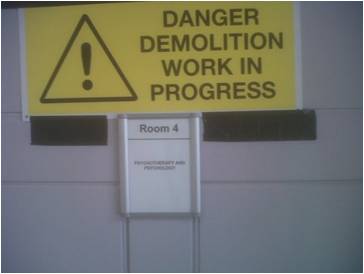
Demolition job at the Citadel (photo by Martin Wrench)
For me, I must own, the grieving continues – and so, via an ongoing oral history, archiving and activism project which I am involved in with colleagues who lived at or worked at the DTC, does the work (that is another, ongoing story!) (I should also mention that the above image was shared with me by the late Martin Wrench, social worker and therapist with the Outreach Team and much beloved comrade.)
I have written before, with Chris Scanlon, my longstanding partner in crime, on the theme of ‘consulting to the out-group‘. Whilst many other services, especially ones that look like they are psychological therapy services of different kinds, routinely offer consultation to the referring service on the ‘difficult patient’ (yes, sorry to say!), the Outreach team offered, in effect, consultation to the potential patient, as to how to negotiate the difficult service.
For the Outreach client, there usually had been a long list of these, but typically (if you forgive for the moment my generalisation) they found themselves caught between Scylla and Charybdis. In the left hand corner, Scylla the sea-monster was represented by a local referring service that often felt they had ‘done all they could’ and wanted to ‘project’ the sufferer away into residential therapy ‘somewhere else’ (and the DTC was a national, and in those days nationally-commissioned service, so sometimes ‘somewhere else’ was a very long way away indeed).
Also, these were the days of so-called ‘world-class commissioning’ – a Blairite coinage, long before Johnson got in on the hyperbole, and the shift in the wind of commissioning towards ‘local services for local people’, while not by any means a toxic notion in itself, was part of what sounded the death-knell for an essential national service that had to be travelled to.
In the opposite corner, Charybdis the infernal whirlpool was a DTC with (to put it mildly) a bizarre-sounding offer of a year’s inpatient stay, far from home, no individual therapy, everything in groups and community meetings, no psychotropic medication, no ‘conditions or coercions’ such as sections of the Mental Health Act or Probation Orders, no locks on bedroom doors and no control, on the part of the staff team, as to admission or early discharge (all such matters being decided by majority vote of the DTC, with residents always in the majority in the electorate).
The Outreach team had the role, and the opportunity, to ‘get alongside’ the individual in this metaphorical Strait of Messina (as Alexander got alongside my forebear in his barrel in the marketplace) and think with them about their dilemma, about how far ‘in from the cold’ it might feel safe enough to venture. The consultation still happened across a power difference (this being very much the norm) but it had, at least from time to time, the effect of disrupting the way power operated in the story.
It stayed with me as a practice, so that later on, in my time at the hospital of which I speak, when asked for example to ‘assess’ the ‘difficult patient’, I would try to take the same approach, of sitting with the individual and jointly assessing with them the chaos or hostility of the system of care around them, thinking with them about what choices they might have or could reach for in such circumstances.
The second point connects to this first: those consultations were almost always set up with two ‘clinicians’ present – for various reasons, I think – one being the sort of fear and dread associated with the ‘one to one’ encounter across a power difference (concerning abuse, and the evocation of abuse), that precluded individual therapy sessions taking place within the DTC itself.
Here I just want to say that the practice has left me with a lasting interest in and active curiosity about practices of co-working, including the co-facilitation of talking therapy groups (or other kinds of groupwork, including community meetings). In ‘debriefing’ a group, where many practitioners might straight away turn their attention to the ‘psychopathology of the patients‘ (heavily inverted commas here!), I will always first want to hear how the co-therapists were with each other.
I am also interested in how that hyphen after ‘co’ – ‘co-therapists, co-production’ – is deceptively horizontal, when the power differential suggests something much more like ‘co\therapist’ (one the ‘expert’, one the ‘trainee’). You can readily guess who’s up on that seesaw when it comes to the fashionable notion of ‘co-production’ of a project or intervention, as between ‘staff’ and ‘patients’.
Lastly, just to say that although the DTC’s links to forensic mental health and forensic psychotherapy settings were much reduced in my time from what, in the 1960s and 1970s, was a very strong connection, in the Outreach service the forensic feel of some of the work was more pronounced. In those years we co-hosted (another hyphen here for discussion!) a series of one-day conferences we called ‘mini-events’ with forensically-oriented services and practitioners within the wider system of care (partly connected to my own training in forensic psychotherapeutic studies) – and lectures from these events were brought together in a co-edited book (that hyphen again! – reasonably level, in this instance, albeit sometimes fraught…) that was published in 2012, four years after the DTC closed.
***************
The immediate upshot of that closure, for purposes of my own narrative here, was two years in the wilderness of the post-closure ‘consultation’ period (the Powers That Be went through the extended motions of affecting to be undecided as to whether the closure should be permanent) – which period I spent, as to those four DTC Outreach sessions, commuting to an eating disorders Day Hospital outside of London while some of those same Powers That Be figured out what to do with me.
The obvious move – to add those four sessions to my three existing ones – was not in fact so obvious, as it would have entailed an increase in the staffing establishment of the London EDS. Also there was a period of time before the decision to farm me out to the day hospital was taken, and that was a bad time for me, in which, for want of anything else to do, and my mind very much on the DTC upheaval (and personal troubles besides), I made rather an aggrieved and disruptive nuisance of myself. Very possibly those ‘Powers That Were’ may have felt they were getting themselves the short end of the stick by having me around more than previously. I can’t say that this was in fact the case, and equally I can’t say I would have blamed anyone for having had the thought, either…
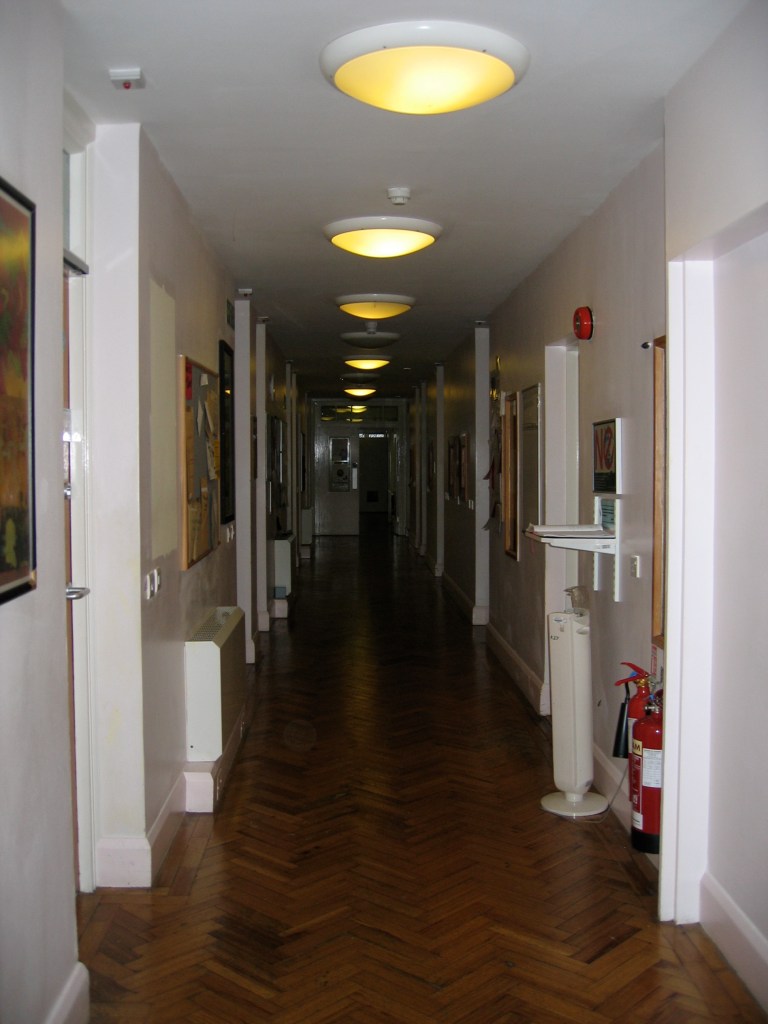
EDS ward – the long corridor
Eventually, though in 2010 my seven sessions were amalgamated under the EDS banner and by about 2012 I had become lead for inpatient psychological therapies on the inpatient ward (not a formal appointment, and perhaps largely by dint of being the last one standing). At this time I also applied successfully for a part time Consultant Psychotherapist post offering Reflective Practice Groups in a forensic setting in another part of London – a job I still have at time of writing. It’s also worth noting that from this point onwards I was working at different grades in the two different NHS posts.
***************
I have written in detail here and here (among other places) about my own journey of understanding in the EDS setting and some of my more clinical conclusions, or rather, let’s say, markers in the hope of new conversations, here. The healthcare politics around the treatment of ‘eating disorder’ were/are constantly shifting and by 2012, if not a little before, the picture was very different from the Service I joined in 2002. A day hospital had opened and the inpatient ward no longer attended directly to the transitional and outpatient care. (I should clarify that in my time there was always an outpatient service – not everything was done by the ward, and of course not every client of the service had inpatient treatment). Bulimia was now treated with adapted outpatient CBT only – although low potassium, the most dangerous physical side effect of practices of purging, could still land one in the general hospital ICU.
The Mental Health Act was now in use as often as not (I no longer have access to the stats, so please take these as broad brush statements, but the direction of travel away from ‘voluntary’ admission was pronounced); naso-gastric force-feeding was now somewhat common on the ward, rather than unheard of; and at about this time a small intensive care bay was developed on the ward, where very severely emaciated patients were treated under theoretically closer observation and in circumstances of greater restriction – a kind of claustrum within the claustrum of the wider (locked) ward. I should also mention that the ward was on the second floor, with no easy access to fresh air – at one point a lift was built, but in my memory almost never worked. The whole building is now destroyed, the ward has moved (still on the second floor, but with better access to the air), and blocks of flats have sprung up on what was hospital land.
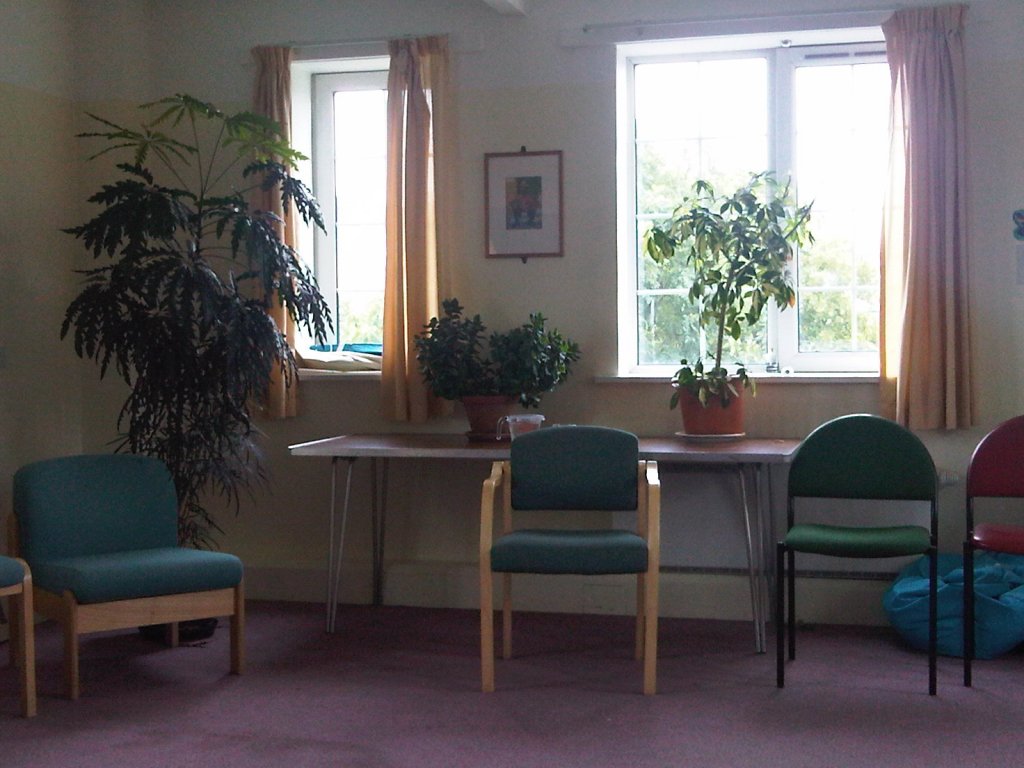
EDS ward – community meeting room
By this time you will already have gathered that the NHS Democratic Therapeutic Communities had closed down. One of the consequences of that kind of cultural vandalism is that a diaspora of survivors, for whom once there was at least the possibility of meaningful and hospitable accommodation within ‘the system’, now were back out in the cold, unpersuadable by the sorts of offers that sprang up in the wake of the passing of the DTCs (for, of course, many who should have been fighting alongside us for the survival of the DTCs, had their eye to the main chance of service development that the moment of their demise had opened up).
Some of these sufferers found their way into these wards (I am not for one second suggesting that this was conscious or intentional on their part! – I am making a psychosocial observation at societal group level) and the ward team’s previously fairly unanimous confidence in the diagnostic categories of eating distress (and certainly mine!) started to break down in the face of complexity and the grievous trauma histories of so many of the patients. This led to sometimes bitter disagreements – over admission criteria, discharge criteria and all points in between.

EDS ward – Leavers’ tree, section
It also illuminated a kind of paradox – for it became clear that the ailment for which one was treated on this ward was malnutrition, rather some construct of a psychiatric condition of tending towards malnourished states. Instead of long full recovery treatments with batteries of therapies, the focus was on reversal of the immediately life-threatening aspects of malnutrition and then – well, onwards, and elsewhere, and be gone – except that the duration of those admissions didn’t necessarily get any shorter, and sometimes got much longer…
The paradox I just mentioned lay in the fact that the only evidence-based intervention to assist with malnutrition is to provide nutrition – to ‘re-feed’ – and yet at the same time the other salient reality was that the patients had all sorts of (fundamentally post-traumatic) needs (I am conscious of ventriloquising, but I think the people that I sat with and got to know there would at least broadly agree) that could not be met within the specific frame of ‘treatment for eating disorders’.
For a while, then, there was an attempt to offer hospitality of a kind – psychotherapy, yes, and psychotherapy groups – but also survivor-led community meetings, action research projects, co-writing projects, external consultation from experts from lived experience, and jointly-generated and curated conference poster presentations, community projects such as the therapeutic eating charter (which you can see in its rainbow format on the wall of the now-demolished ward dining room in the image below – I am assuming that this rainbow was also destroyed, but would love to hear otherwise!).
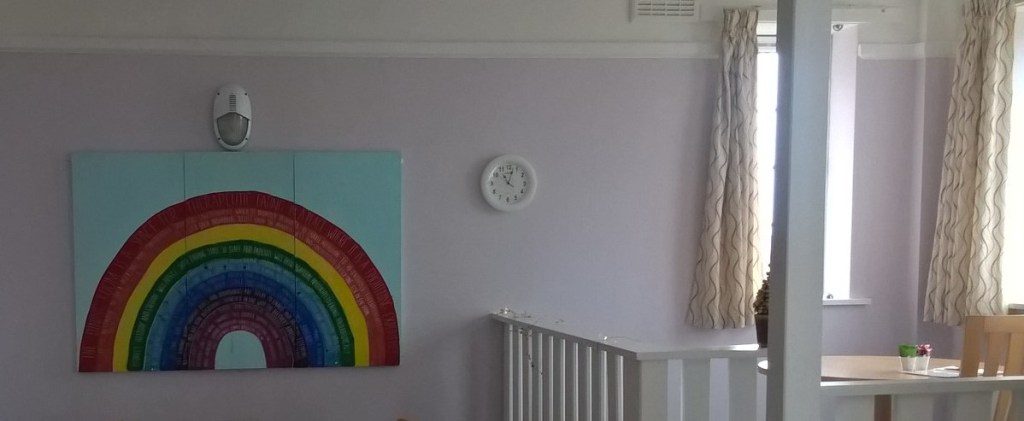
EDS ward, the dining room
Also, by this time, I had trained in Mentalisation Based Treatment (MBT), one of the various ‘three-letter therapies’ lately in vogue. In about 2013/2014 we had the whole multi-disciplinary team trained up in MBT skills to practice, not so much as therapists in the consulting room, but in ‘corridor conversations’ and other ordinary encounters on the ward (and extraordinary ones, in the dining room for example) – in pursuit of the undeniable principle that it is more helpful to ‘mentalise’ the other, to keep the other’s mind in mind, than to fall back on ‘othering’ ‘them’.
***************
Some things work for some people, when it comes to therapy, and the therapeutic milieu – and there’s nothing that works for everyone. The only thing we really really know about talking therapies is that it’s the relationship between therapist and patient what wins it, if anything does win it, and the rest is nuance and fine lines and the particular case and the narcissism of minor difference (as between the protagonists of the competing three-letter therapies, or psychoanalysts versus everyone else).
I know that some people felt immensely helped by this shared, psychosocially and psychodynamically informed milieu approach that for a while we were able to offer and sustain. I also know that the psy therapies are only a small and perhaps an overvalued part of the overall offer in such a setting. I am still haunted, what is more, by those who I got to know so well and so deeply, but who in the end did not survive. And I do not use the word ‘haunted’ lightly.
So this is not the place, and I am not in any position, to make any special pleading that I personally was ‘right’ about anything. I can only adduce one fact with confidence. In 2018, after another long and intensely bitter and debilitating ‘consultation’, and in the face of considerable protest, psychotherapy was cut from the ward – along with the two remaining psychotherapists – in favour of (at the time) a brand new manualised three-letter therapy, CRT or Cognitive Remediation Therapy.
I suspect that we were felt to have become too hospitable – that the length of stay, a most erratic barometer of ‘progress’ in such a setting, but a numerical metric to the spreadsheet-minded, was felt to be increasing, and that psychotherapy and the milieu approach and a flattening of hierarchy were together felt to be ‘encouraging’ patients to ‘settle in’ for the long haul, even (Heaven forfend!) to ‘make themselves too much at home’. And I would be the last to argue for longer stays as such, or to wish even a week of treatment in such a place upon anyone – or perhaps more to the point, to wish even a week, upon anyone at all, of the kind of soul torment that brought people to our door. I also feel fairly sure that the team, and certainly not our senior managers, were no longer united behind the approach, and therefore, all other factors aside, for this reason it was not sustainable.
But such are the eternal dilemmas of (especially ‘specialist’) inpatient treatment in the psychiatric system of care. There is always, as already mentioned, a terrible and terrifying ‘bump down’ from the claustrophobic intensity of inpatient care to the agoraphobic wilderness of outpatient care. It’s also important to keep in mind that inpatient care is ’24-7′, but not in the sense that there is a consistent experience of being cared for.
On the contrary (and leaving aside what may be the terrors of the care offered and received) the inpatient experience is more (I think – again being wary of ventriloquising, but this is what the patients taught me) of the ‘lighthouse beam’ (to borrow a term from one of my supervisors) of care and attunement being upon one momentarily, or for a session, say, but then moving on to someone or something else and leaving one just as much in the dark as if one were not ‘in inpatient care’ at all….
There is also, almost literally, nowhere to go, in terms of that forty year old chimera, ‘care in the community’. We still do not yet understand the full consequences of Austerity Mark One – or the pandemic – let alone the perverse horrors of a Labour government driving Austerity Mark Two.

The old EDS ward – still life with bulldozer
***************
Psychotherapy was out of fashion, then, and out of favour, and EDS psychotherapists still standing by then were very few, but had still to be disposed of. I went through another period of uncertainty while the Citadel decided what to do with me. The interested reader might be intrigued to learn that there is a kind of secret NHS slush fund for paying off employees when the Citadel can’t afford the redundancy payments but can’t risk putting the person through yet another more or less violent redeployment for fear of litigation. I hasten to add that I had no thought of such retaliation. But it’s interesting that I must have looked like I was capable of it, and that it was a thing worth ‘their’ while avoiding.
In the end – eventually – I was relatively peacefully ‘rationally redeployed’ (ie ‘an offer one cannot refuse’), down just one flight of stairs in the same (now bulldozed) building, to an outpatient Complex Needs Service, six sessions a week (down from seven, but whatever!) to practise outpatient Mentalisation Based Treatment (MBT).
There I made, gradually, the best, I think, of my peremptory eviction from the other service, by picking up the facilitation and management of the treatment group for Young Adults (18-25). Over the next seven years I helped to make the Young Adults Project into a service within a service – a model that may now be replicated in other boroughs within that organisation.
The history here, and my own departure, is much more recent and I will accordingly limit myself to two comments. First of all I want to pay awestruck tribute to the truly amazing people who were clients of the Project over those seven years. I was thirty years old before I got my own self anywhere near intensive psychotherapy, and I never took the risks that these brilliant younger people did, in coming into therapy with us.
Secondly, I want (again!) publicly to deplore the fundamental dishonesty of the euphemism of ‘Complex Needs’ within the term ‘Complex Needs Service’ – especially when, in pretty much all the conversations about the pathway that take place in boardrooms inside the Citadel, the toxic attribution of ‘personality disorder’ – and its even more toxic acronym ‘PD’ – remain the main terms in circulation.
You can’t have an ‘evidence-based’ treatment for a non-existent illness entity. Too many people have died of the attribution, the stigma, the impact of the discourse around it on the way services think about treatment – in my direct experience of this last quarter century. The system of care needs to take the bulldozers to that whole edifice, and all of the language and discourse around it, and build a new one from scratch. We are all human and (therefore) we are all flawed. The diagnostic taxonomy of the fiction of ‘personality pathology’ is a haunted house of horrors. We can’t just put up a new sign over the door, and carry on as if ‘nothing happened here’.
***************
This piece has ended up much more akin to a book than a blog. I will therefore make one more reference, and then leave you with a thought. Thank you again, for lending me your ear.
As I was approaching the finishing line of this piece, which was written in fits and starts over four or five weeks, I became aware of a very excellent piece written by someone I know in a different setting, that was published just a week ago. Its called “The ‘Impossibility’ of working in the current NHS: sacrifice to a primitive god” – which is a fabulous title for a paper – and I absolutely commend it to you, I don’t want to say that my blog here is exactly a companion piece to my colleague’s article, but there are some clear resonances, and she covers the period 2008-2018, which is precisely the period bookmarked for me by the two violent redeployment processes that I have here described.
As for myself, I give myself over now to the judgment of my readers, as I promised to begin with. My reflection, now that I have written what I have written, is that it’s not only that I await your judgement. I realise that in some profound sense I long for your forgiveness.
This is complicated, and I’m not presuming to ask for it, still less to expect it. And you will appreciate that I don’t mean your forgiveness for having taken more than 5500 words to say all this – I realise of course that such self-indulgence can’t be allowed to pass!
No, it’s something different, something deeper and murkier – something uncanny, perhaps. And it’s not the ‘forgiveness of the authorities’ – to borrow a line from John le Carre’s ‘Smiley’s People’ – I’ve been quite a nuisance to you-the-authorities at times (perhaps not often enough), but so have you been far more than a nuisance to others (your nuisance to me, I count as of no moment, not in the scheme of things).
No. I think it’s the forgiveness of the patients, the survivors, and those that did not survive, that I long for – but cannot venture to plead for, since I have no right to such forgiveness, and no right even to ask for it. I can only offer reparation.
Perhaps this piece of writing – and its being published here in the agora – may stand as some very small part of such an offering.

EDS ward – Mural section (‘smoking balcony’)
Afternote: I have tried to be careful, and have selected out images of particular discrete artworks, or cropped out specific identifiers, but there is definitely some ‘patient’-generated artwork visible in some of the images I have used, and possibly one or two of the photographs from the EDS ward were also taken by patients (and shared with me (in 2011, as part of a ‘co-production’ project, I think)).
I took some of the photos (definitely of the DTC patio, and the bulldozer, and the title image), but can’t now be sure, as to the other images, which are which. My records, I’m afraid, now fail me as badly as my memory. If anyone sees these images and can identify themselves – and would like to let me know, and as an option to request a named acknowledgement – I will be very happy to edit the blog accordingly.
 Barrelblog