Ida smiles

I am reblogging this poem of mine from the Atrium WordPress site where it was published today – many thanks to the Atrium team – Claire Walker and Holly Magill – for believing in this poem and giving it a platform. A second poem of mine is appearing via Atrium next month!

To go to the Atrium site to view the poem, please click on the title hyperlink within the box above.

‘Lifestyle choices’ revisited

“…the caterpillar and fly/Feed on the Mystery/And it bears the fruit of deceit/Ruddy and sweet to eat…” (The Human Abstract – William Blake)

How do we solve a problem like Suella Braverman? The UK Home Secretary has been on a certain ‘social media’ platform, positioning herself for the Conservative Party leadership election and doing her bit to lean on the King’s Speech coming up on Tuesday (which will announce a legislative agenda this government does not have enough time left to fulfill before a General Election next year). She has said, [and I vomit quote][especially vomit-comment-worthy sections in bold, because that’s as much as I can bear to have to do with them for now]:

“The British people are compassionate. We will always support those who are genuinely homeless. But we cannot allow our streets to be taken over by rows of tents occupied by people, many of them from abroad, living on the streets as a lifestyle choice. Unless we step in now to stop this, British cities will go the way of places in the US like San Francisco and Los Angeles, where weak policies have led to an explosion of crime, drug-taking, and squalor. Nobody in Britain should be living in a tent on our streets. There are options for people who don’t want to be sleeping rough, and the government is working with local authorities to strengthen wraparound support including treatment for those with drug and alcohol addiction. What I want to stop, and what the law-abiding majority wants us to stop, is those who cause nuisance and distress to other people by pitching tents in public spaces, aggressively begging, stealing, taking drugs, littering, and blighting our communities.”

Let me first of all say that really there is nothing to be done with the Home Secretary but count down the days to her inevitable eviction from office, and to see if she can then tell the difference between a lifestyle choice and a survival strategy. If we fixate on her words, on the world view they express, and the attack on the agora that they represent, as being her words – the abhorrent verbal excreta of a particular populist politician, no more, no less – we are seduced into imagining that the words will go away when she goes away – or worse still, that the words will go away if we stick our fingers in our ears and wish for them to stop.

No, the thing to do is to understand this rather cowardly woman (so much for nominative determinism!) to be spokesperson for an in-group as it wages continual war – across a battlefront running through society, as Foucault put it in Society Must Be Defended – upon an out-group which it displaced in order to gain power and which it needs to keep subjugated so that it retains power. The main weapon in the in-group’s armoury, now that one can no longer be executed in the UK for treason, heresy, or being an ‘enemy of the common weal’, is the deceptively simple ‘biopolitical’ practice (Foucault again) of projecting responsibility for the original displacement and the ongoing state of unsettledness from the perpetrator (the in-group who did the un-housing in the first place) into the victim (the displaced out-group, now constructed as having made lifestyle choices to be homeless, workless or Stateless).

Conscious that referencing Michel Foucault and Karl Marx and disrespecting the incumbent of a high office of State in this country may get me prosecuted for undermining the institutions of said State under other proposals to redefine ‘extremism’ pre-leaked to be announced by the king at the opening of Parliament tomorrow, I must, nothing daunted, go on to remind us all that it was old Karl himself who first or most famously pointed out that (in our language now) the in-group first of all evicted the proletariat from the land (by means of Enclosures of the commons, and other such devices) and then criminalised (via the early Poor Laws) having no fixed abode or gainful employment. If you were caught three times on the road without proof of address or work and no evidence of severe physical disability, you were not (pace La Suella) ‘genuinely homeless’ and could be executed for being a ‘sturdy vagabond’ with past form.

Successive bouts of legislation have compounded and reinforced this original offence, including the 1824 Vagrancy Act which is mentioned in the newspaper article hyperlink above, due to be repealed. The Braverman attacco di vomito is simply one, scarcely even egregious, link in a very long chain of counter-revolutionary class warfare of the kind in which the land-owning culture-carrying in-group in this country has been specialising all the way back to the early Middle Ages – as quintessentially English, if you will, as warm beer, or religious bigotry, or capitalist/Imperialist rapacity, or race hatred, or air pollution, or a game of cricket on a village green.

Yes, Officer, I will come quietly…

My barrelmate Chris Scanlon and I have been exploring this territory – and (spoiler alert!) exploding the toxic mythology that there might be such a psychosocial phenomenon as ‘ungenuine’ homelessness – for two decades now. La Suella is very welcome to a complimentary copy of our book published last year, in which we wrote:

“We locate ‘the problem of homelessness’ in the continuing inability, of this society in which we live and of those systems of care in which we have been working, to recognise and to integrate, into its responses and interventions to this problem, both the sociological fact of dispossession or not having a ‘fixed abode’ and the psychological experience of feeling disrespected or of not feeling welcomed or accommodated. Our concern is therefore with what it might be like to not have a place to belong – with the experience and the phenomenology of ‘vagabondage’ – of what it might feel like to have nowhere to go and no-one to turn to in order to feel ordinarily safe (or safe enough) or to find refuge or asylum.”

There is much more to be said, and much that has already been said. I suppose we might find it at least vaguely heartening that even the odd Conservative Minister (and o my! are they not an odd lot, or what?) has baulked at entirely going along with Yella Suella on the ‘lifestyle choice’ point. But next time you hear something like this, be sure to be quite clear, that what you are hearing is the sound of someone who has built their pile on the bones of little people, calling some other little people ‘vagabonds’, to license and sanction some further bone-crushing and pile-building.

And know also, that although this has been going on for half a millennium and more, nonetheless, somewhere, sometime, it will reach its limit – and then a day of dreadful reckoning may be anticipated.

Mau-Mau, colonial violence and restorative justice: what Charlie said next?

The King of these little islands revisits the scene of some of the many crimes of Empire today, when he returns to Kenya for his first ‘State’ visit to a Commonwealth country. The Kenya Human Rights Commission has called upon him “on behalf of the British government, to issue an unconditional and unequivocal public apology (as opposed to the very cautious, self-preserving and protective statements of regrets) for the brutal and inhuman treatment inflicted on Kenyan citizens”, especially but not exclusively during the so-called ‘Emergency’ period from 1952 to 1960, when Kenyan people were fighting to gain their independence from the British Empire – a fight that concluded in December 1963.

The British government (in the unlikely person of William Hague) admitted back in 2013 to much of the torture and abuse – but ‘without prejudice’, and only after the Foreign and Commonwealth Office had vowed to fight to the death the class action brought against it, led by Wambugu Wa Nyingi, Paulo Muoka Nzili and Jane Muthoni Mara, parts of whose testimony you can find here.

It has been widely trailed that some ‘diplomatic’ form of words is making its mangled way through the royal intestinal system, acknowledging painful history in some form or other – and I must immediately say that it is not for this White barrelman – accessory after these facts as I am – to pronounce as to how these words might be received by those to whom they will be addressed.

But a Cynic can dream (it’s only a cynic who can’t!), and it’s been on my mind a while to imagine what Charles might say, if – well, probably if he were other than who he is – but let’s give him the dubious benefit of some very considerable doubt, and imagine a man wrestling nightly with Angels, and scribbling in secret ink beneath the royal duvet, plotting to elude the scrutiny of his minders…..

“Ladies and gentlemen, my distinguished and honorable hosts, I am most humbly grateful to you for what in all the circumstances is your most extraordinarily gracious invitation to me to join you here today, and for the warmth and generosity of your welcome.

My heart is full, for I have vividly before my eyes the scenes seventy-one years ago, when my beloved mother was staying in this land under perhaps very different circumstances, when news reached her of the death of her father – and this is the first time I have ventured upon such a journey since her own death.

However, although I am my mother’s son and the ceremonial head of State of the Commonwealth, I speak both in that role and also as a man, as a fellow human being, when I say to you today that my heart is heavy for a greater and more solemn reason.

I am come before you both with the ceremony of State and with personal humility, to make apology, reparation and restoration, and to ask, how reparation and restoration, having been begun, might be continued, until justice has been seen to be done.

For I and my people have wronged you and your people – we continue, in both intent and effect, to wrong you – with our public minimising and our knowing private racism and our continuing economic warfare – and it is entirely clear that we must wrong you no more.

In case anything thus far is not clear: your Human Rights Commission has asked that I, on behalf of the British Government, issue, and I quote their words: “an unconditional and unequivocal public apology (as opposed to the very cautious, self-preserving and protective statements of regrets) for the brutal and inhuman treatment inflicted on Kenyan citizens”.

I do apologise: unconditionally, unequivocally, wholeheartedly. More: I hang my head – personally as well as ceremonially – in shame.

My people came among you long ago, and we were beside ourselves with greed and bloodlust and possessed of an utterly misplaced religiosity, moral fervour and blind self-righteousness. We imagined ourselves super-humans, and we constructed you as sub-humans. We destroyed your way of life with the rapaciously calculated imposition of our own local land and property laws; we set you against each other; we exploited your land and extracted its treasures; and when you mobilised yourselves in protest and uprising, we were brutal and sadistic and devoid of ruth or shame in the manner in which we unhoused and abused and tortured and slaughtered you in order to subjugate you anew to our power.

You have, here and now, this my apology. I hope you may find that it means something to you, and that you may speak freely to let me know what it might mean. For it is not for me to say what it should mean. It is long past time for the likes of me to give up the evil habit of dictating meaning to others.

But now, if I may, I have a follow-up question, which I shall ask, and then stop speaking – for my next words will depend upon what answer you may give. Here is my question:

“What now, what next? What would be most helpful? What would you ask of me – of us?””

Well. It’s five hours later on. Let’s see what he did actually say…(I have marked in bold the bits where an active mode or a possessive article or a less ambinuous possessive article than ‘we’, or a spot of detail about who did what to whom would have helped, but was missing)

“….However, we must also acknowledge the most painful times of our long and complex relationship.

The wrongdoings of the past are a cause of the greatest sorrow and the deepest regret.

There were abhorrent and unjustifiable acts of violence committed against Kenyans as they waged, as you said at the United Nations, a painful struggle for independence and sovereignty – and for that, there can be no excuse.

In coming back to Kenya, it matters greatly to me that I should deepen my own understanding of these wrongs, and that I meet some of those whose lives and communities were so grievously affected.

None of this can change the past. But by addressing our history with honesty and openness we can, perhaps, demonstrate the strength of our friendship today.

And, in so doing, we can, I hope, continue to build an ever-closer bond for the years ahead.”

So there it was. As I already mentioned, it’s not for me to say how that should have been received. But you can see that The Firm lawyered up, because the ‘wrongdoings’ are rendered in the passive voice. Nobody can tell from the speech what the wrongdoings were; who did them; who regrets that they were done; or who should not be looking to make excuses. The only perpetrator named is ‘the past’ – as in: ‘the wrongdoings of the past’.

The speech has already been marked as ‘a miss‘. This was a non-apology, a finely tuned piece of Doublespeak dressed up as an olive branch. It may even be a welcome branch, and/or one worth grasping. Perhaps it was enhanced in private, off-stage. But it was a long way from being able to stand as a piece of restorative practice in the agora.
Omphalos

It’s been quite a while since I posted here. This is not because there’s been nothing to rage about – it may possibly have been because there’s too much. I have yet to find words for Bibby Stockholm syndrome, to pick but one issue out of the jar … but I have been writing a poem, and thought I would share it here.

Diogenists amongst you will likely spot the poem’s oblique reference to that old-school barrelman, because a pivotal moment in his story comes when he pages the oracle at Delphi and gets the puzzling exhortation to go forth and do what he thought he’d already got done for: namely, to ‘deface the currency’.

For all we know today, the Pythoness (the priestess of the temple, who channelled the word of Apollo) may have been looking backwards into his story rather than forwards – or the priests who used to scribe and reformulate her words may have misheard – but Diogenes takes it that he must deface the political currency, and thus a legend is born …

This poem plays on the fact that the area of Paris known as Montparnasse, where a famous and beautiful cemetery is located, is named for Mount Parnassus in Greece, upon the slopes of which the temple of Apollo at Delphi was built. The Greek peoples of those times believed that the site of the temple was the centre of the world as marked by Zeus and that the stone (‘omphalos’) that he placed there was the world’s belly-button – and that this is why the Word of Apollo could be heard so clearly.

This particular Barrelman has never yet visited Delphi, but I have more than once had the good fortune to be able to wander around Montparnasse – and so here is my poem, and I hope you enjoy it:

Omphalos

I.

By the Seine we are secret lovers
let suddenly loose. We float lazily
about the citadel, fey and febrile
as the river’s grey surge and swell;
we sip coffee at Les Deux Magots, spy
something magical

glittering in the eyes of each passer-by,
drift hazily down the Rue Mouffetard
towards the catacombs, and all the while
I dare not forgo the feral heat
of your hand in my hand – we are Héloïse
and Abelard – we are Bogart and Bacall –

we are Jean-Paul and Simone –
no doom may daunt us, no death outrun us.
At Montparnasse cemetery, in the orange gleam
of a faltering mid-September sun, we flit between
the tombs and ossuaries like zephyrs,
fleet and phantasmagorical,

whispering with the shades of Baudelaire
and Beckett, sifting the leavings of grass and gravel,
lifting dust and petals from the graves. Feeling our way
to the far wall, we place two twenty-centime pieces
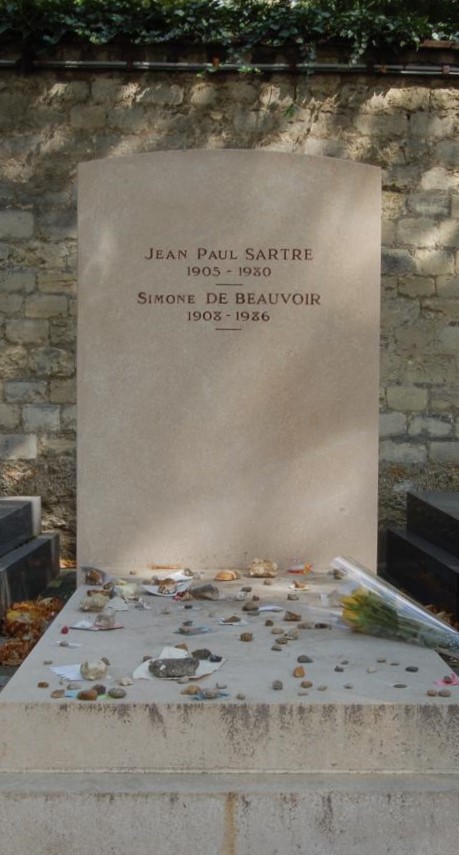
on the bed that Sartre and de Beauvoir share –
wishing on a morning’s quiet miracle.

II.

Tracing tired steps
back towards the Latin Quarter,
we chance upon a backstreet stairway, a door
stood ajar, warm air rising from a basement bar,
a saxophone dancing, splintering the stillness
of the midnight in soaring lyrical

frenzy, and I conjure an image
of the Pythia at Delphi, the cadences
of her vocalisations like trailing vines
snaking between the cracked and crooked
ancients of the olive groves, her wailing
words like strings of coracles

bobbling, riding torrents of breath,
cascading down Mount Parnassus
towards the banks of the Pleistos – writhing
in delirious inspiration, veiled in flame,
wreathed in the fumes of volcanic vents –
her serpentine divinations, allegorical

and tenebrous, woven into parables
for philosophers to parse, or princes to puzzle –
a sulphurous jazz priestess of the high passes,
a bebop Pythoness jiving at the world’s navel,
improvising the cryptic Apollonian
song-lines of her oracle.

The image of the tomb of Sartre and De Beauvoir was taken by Angela Signorastri. The image of the temple ruins at Delphi is by Luarvik/Wikimedia, reused under creative commons licence: https://commons.wikimedia.org/wiki/File:The_Temple_of_Apollo_at_De: lphi.jpg

100 Jamaican individuals and organizations sign open letter to William and Kate ahead of their visit

…this passionate declaration of intent says all that needs to be said about the very ill-advised recent travels of William Windsor and his partner, trying to shore up the Family’s business reputation at the very scene of the crimes against humanity that the Family both precipitated and prolonged and for so long profited from…👏👏

petchary's avatarPetchary's Blog

I am sharing below the Advocates Network’s Open Letter to William and Kate, who bear the titles “The Duke and Duchess of Cambridge.” The letter is signed by 100 individuals (including myself) and organizations. The royal couple will arrive in Jamaica on Tuesday, March 22 and depart on Thursday, March 24, as part of their Caribbean tour.

Dear William and Kate: Why not just say you are sorry?

March 20, 2022

Open Letter to Prince William and the Duchess of Cambridge Kate

Dear William and Kate:

We note with great concern your visit to our country Jamaica, during a period when we are still in the throes of a global pandemic and bracing for the full impact of another global crisis associated with the Russian/Ukraine war. Many Jamaicans are unaware of your visit as they struggle to cope with the horrendous fallout of the COVID-19 pandemic, exacerbated by pre-existing social…

View original post 1,506 more words

The ‘supercharged champions’ of free trade versus lockdown: imperialist discourses in times of pandemic

This is an edit/update of my previous blog on these themes from last April

‘…in that context, we are starting to hear some bizarre autarkic rhetoric, when barriers are going up, and when there is a risk that new diseases such as coronavirus will trigger a panic and a desire for market segregation that go beyond what is medically rational to the point of doing real and unnecessary economic damage, then at that moment humanity needs some government somewhere that is willing at least to make the case powerfully for freedom of exchange, some country ready to take off its Clark Kent spectacles and leap into the phone booth and emerge with its cloak flowing as the supercharged champion, of the right of the populations of the earth to buy and sell freely among each other.

And here in Greenwich in the first week of February 2020, I can tell you in all humility that the UK is ready for that role…’

A B deP Johnson, Greenwich, 3 Feb 2020. https://www.gov.uk/government/speeches/pm-speech-in-greenwich-3-february-2020

It’s wearisome and dispiriting – but supremely predictable – that, throughout the present pandemic, the two decadent imperialist Anglo-Saxon democracies of the West have been gliding, in synchronised steps, in and out and round about to that old country waltz whose tune we all know so well. You know the one I mean – it goes like this: “blame the exotic, inscrutable and untrustworthy Orient”. The (temporary?) fall of Trump has not had much impact on the rules of this particular game (Guardian, May 2021).

In this present case the fall guy is supposed to be China; its particular ‘villainy’, the COVID-19 pandemic. As always, with all the most effective lies and projections, there is some kind of hook to hang this on: in this case, the ‘wet markets’ of Wuhan where the zoonotic calamity of COVID-19 is understood to have originated. A recent refinement of this dynamic presents a neat either/or: the idea that the virus might have originated in a laboratory of the Wuhan Institute of Virology rather than in the horseshoe bats sold for meat to market. However, once it becomes clear that the particular example is but a manifestation of the general discourse, the details don’t matter so much.

To offer an example of what I’m getting at: at the height of British imperialism, in the days of Lord Palmerston and ‘gunboat diplomacy’, China was also the Oriental villain. At the time of the Opium Wars it was demonised for having the immortal rind to put the welfare of its own population (protection from substance dependency) above the principles of Free Trade (drug dealing, as we would now call it) espoused (down the barrels of its cannon) by the Occidental merchant classes (who of course considered it their God-given right to control the terms of engagement).

Not the least of what it is about the COVID-19 catastrophe that enrages the neoconservatives on both sides of the Atlantic, is precisely that it causes them to lose control of the terms of trade. They are entirely prepared to see large swathes of their own populations as expendable and sacrificial; but deferring to ‘the Orient’ on matters of commerce is more than they can bear to swallow (Amitav Ghosh writes wonderfully about this in his Ibis trilogy).

The great founding theorist of post-colonial studies, Edward Wadie Said, wrote beautifully and incisively about the long and toxic tradition of ‘othering’ (“disregarding, essentialising, denuding the humanity of another culture, people or geographical region”) that characterises the West’s historical relations of domination towards and over the ‘East’. This is what was happening when people were muttering about ‘other’ people eating ‘exotic’ animal meat that they wouldn’t fancy, or referring to COVID-19 as the ‘Chinese’ virus (something equivalent happened around the ‘Indian’ variant before the WHO went back to the Greek alphabet: the ‘Delta variant’ is a trickier hook upon which to hang racist tropes).

It’s 5500 miles or so from Wuhan to London as the crow physically distances. Even in globalised late modernity, that’s a long way. But it’s not just that the distance breeds contempt and that it describes fertile ground upon which the populists may sprinkle their toxic seeds of othering. It’s more precisely that Empire, whether in its economic or its political or its symbolic dimensions – the British Empire, for example, of the second half of the eighteenth century, or the fossil capitalism that fuelled it, the profits from chattel slavery that launched it, or the doctrine of white supremacy and colonial domination that structured it – Empire defines itself as a system where the ‘darkness’ is always ‘at the edge of town’, even if that darkness sometimes makes itself felt by means of tendrils slithering inwards towards the centre.

The so-called ‘Winter of Discontent’, 1978-79, in the UK? Must have been those pesky Russkies that fomented it! It can’t have been anything intrinsically problematic about our own system of government. The Bay of Pigs; Checkpoint Charlie; the Vietnam War; Bikini Atoll; the Roswell UFO ‘sightings’: all of them extemporisations over one single repeating riff. “Peace at the center is dependent on the successful maintenance of conflict at the periphery”, writes Jonathan Lear, in his brilliant essay on JM Coetzee’s novel Waiting for the Barbarians. Border skirmishes, in this view, be they minor or major, are not only distractions and exotica – they are necessary, sine qua non; and, to borrow from Bob Dylan, if you lean your heads out far enough from Desolation Row, you’ll always be able to hear their dog whistles.

The Empire must expand, so it must clash with whatever lies immediately beyond its pulpits and parapets – especially if what lies beyond its pulpits and parapets, across a hundred yards of no-man’s-land, are the parapets and pulpits of some other Empire, committed to the exact same doctrine of never-ending expansion, fuelled by the very same fossil fuels that power the delivery trucks and the battle tanks of its rival, and underpinned by a looking-glass replica of those very doctrines of mission and Providence propounded from the pulpits of its rival.

So the COVID-19 pandemic cuts a lethal lighthouse beam of illumination through the darknesses of wet markets, boundary violations, cynicism (with a small ‘c’), venality and hubris – but it’s not the venality of the ‘feckless Oriental’, nor the cynicism of the embattled frontier towns and outriders of Western mercantilism and extractivist imperialism. No: COVID-19 shines its light upon the epicentre of Empire; upon the darknesses we try to expel to the edge of town, that our cosy streets may feel safely lit and peaceful; the peoples and landscapes we give up in sacrifice in order that we may continue tightly to cling to those twin illusions of surplus and sustainability. COVID-19 strips bare, with its laser lens, the hubris of human relations of imperialist and supremacist dominion over the animal ‘kingdom’.

As the UK government stands poised to put dates over data and ‘open up the economy’, while projecting responsibility for pandemic management into the individual choice of the neoliberal subject as to whether to wear a mask on public transport (the mantra of ‘common sense, not diktat’), COVID-19 shows us clearly that Free Trade remains the ideological imperative and that Johnson and his cronies have learned nothing from experience of the intervening year and a half of devastation (and the four millions who have died of the virus) since he made that speech in Greenwich.

Above all, the pandemic exposes the illusion at the heart of Empire: the illusion that humankind, or some part or portion of humankind, may in actuality wield dominion over anything at all. This illusion rose up in the ultimately futile campaign to overthrow the knowledge that on some level we all began with: the awareness of belonging as interactive components within a wider Earth system, living in attunement with all other components of that system, ‘animate’ or otherwise.

Much has been mumbled, along the way, of COVID-19 as the revenge of Gaia. This position is not persuasive – Gaia has no intentionality, pursues no telos, upholds no greater good. Gaia is vast and intricate and we are in it and of it.

COVID-19 simply shows us how small we are.

References

Bob Dylan (1965) ‘Desolation Row’, from Highway 61 Revisited. Columbia Records.

Amitav Ghosh (2009) Sea of Poppies; (2011) River of Smoke; (2015) Flood of Fire – The Ibis Trilogy. London: John Murray.

Guardian (2021) https://www.theguardian.com/us-news/2021/may/27/biden-china-coronavirus-origins-beijing

Jonathan Lear (2018) Wisdom Won From illness. Cambridge, MA: Harvard University Press.

James Lovelock (2007) The Revenge of Gaia. London: Penguin.

Edward Said (1978) Orientalism. London: Penguin Modern Classics.

Edward Said (1994) Culture and Imperialism. London: Vintage.

Bruce Springsteen (1978) ‘Darkness on the edge of town’, from Darkness on the Edge of Town. Columbia Records.

On violent states and creative states

Violent States and Creative States – From the Global to the Individual

John Adlam, Tilman Kluttig and Bandy X Lee (eds) – Jessica Kingsley Publishers (2018)

https://www.jkp.com/uk/violent-states-and-creative-states-2-volume-set-1.html/

Violence often feels like it comes ‘out of the blue’. This contention might almost be intrinsic to any account of the experience of any individual who finds themselves ‘on the receiving end’ of an act of violence. Repeated violence, almost by its very nature, risks ceasing to be perceived or experienced as violence at all – think of patterns of domestic violence or self-injuring practices – or the tweets of the President of the United States – or the newspaper columns of the United Kingdom’s recently-resigned Foreign Secretary.

And yet: human behavioural violence is not random. It involves an agent – the doer of the violent deed. In turn, the violence of this agent emerges out of the self state, the state of mind, of the agent: an act of violence is the external expression of an internal state of mind. James Gilligan, who contributed the epilogue to these volumes, has argued that all interpersonal human violence comes down to feelings of shame and humiliation and feeling disrespected.

From a psychodynamic perspective we might characterise such states of mind as unstable states in which a ‘bad object-relation’, a node or nexus of tension and aggression and ambivalence, experienced as intruding upon the self, has to be evacuated in pursuit of the unconsciously hoped-for restoration of equilibrium. Put (much!) more simply: I feel shamed or ‘dissed’ – there’s then a relationship in my mind between ‘me-who-is-dissed’ and ‘he-who-dissed-me’ – the feelings associated with this are increasingly difficult to tolerate – eventually I lash out at someone else ‘out of the blue’ – at least momentarily, I am powerful and someone else has the bloody nose or the black eye – the feelings associated with ‘me-who-was-dissed’ are no longer available, they belong now to the person I have humiliated in turn.

It was ‘out of the blue’, for me, when, working a cold weather shelter one winter’s night (if the reader will accept testimony from my own experience), I was suddenly attacked from behind and thrown to the ground by a homeless man who had taken refuge there. But it wasn’t ‘out of the blue’ for my assailant – I suspect his violent state of mind had been building and bubbling a while – and so might mine have been, if I had been out and about that freezing night on the streets of South London.

What finally did it for him (I have many times since reflected) was probably when I happened to turn my back towards him (in order to go fetch something, as I recall). His violent act emerged out of his violent state and was ignited by his experience of the violent, humiliating or shaming disregard that I (inadvertently) performed for him. And then we must imagine the kind of life experiences that had led this man into this particular predicament – and reflect upon the violent State that might be understood to obtain, when the sixth largest economy on the planet can’t quite manage to meet the basic housing and social care needs of its vulnerable populations.

This two-volume set of essays on violence and creativity has at its centre the observation that even individual or behavioural violence occurs within an ecology that encompasses not just immediate family and community but society as a whole. We hope to show that, just as an individual can be in a violent state of mind, societal structures can take on ‘violent states’ – not only in the political construct of the ‘rogue state’, but in the sense that anti-Semitism or Islamophobia or misogyny or neo-liberalism or biosphere destruction might be understood as ‘violent states’ that effect harm to the body politic (and also give rise to individual violence).

Those who lost their lives in the Grenfell fire, on this view, died not ‘simply’ of smoke inhalation ‘out of the blue’; they died of an ongoing slow-boiling ‘structural violence’ – just as the victims of Hurricane Katrina in New Orleans did not die of drowning, so much as they were killed by structural violence at Federal and State level: by the failure to repair the Mississippi levees and by racial segregation pursued in public policy by covert means (which latter factor is explored in the first contributor chapter in these books, on the violent State of racial segregation in the housing policy of Baltimore).

Throughout the thirty-two chapters of these two volumes, we invite the reader to position herself in the liminal spaces between two pairs of concepts: in the interplay between violent states of mind and violent States of society; and across the subtle distinctions or the mysterious fine line that may separate a violent state, of mind or society, from a creative one.

Violence begets only violence. This book project is first and foremost an activist project: we are looking to contribute to violence reduction, not only to the theory of violence reduction. We also hope that our authors may have helped to shed light on the wellsprings of human creativity: how a destructive death impulse and the healthy, creative life impulse, may be inter-related; how to divert the flow of human destructiveness into more creative channels, at the level of the nation State and the global community as well as in individual states of mind.

In a creative state of mind, unbearable experience can be integrated into the psyche instead of needing to be got rid of; likewise in a creative State, the feared or hated ‘other’ is not expelled, be it an idea or an individual or a people – the ‘other’ instead is received, engaged with, respected, accepted, even celebrated. In these dark times, that’s not just a project and a book worth launching – that’s more like an urgent and overriding imperative.

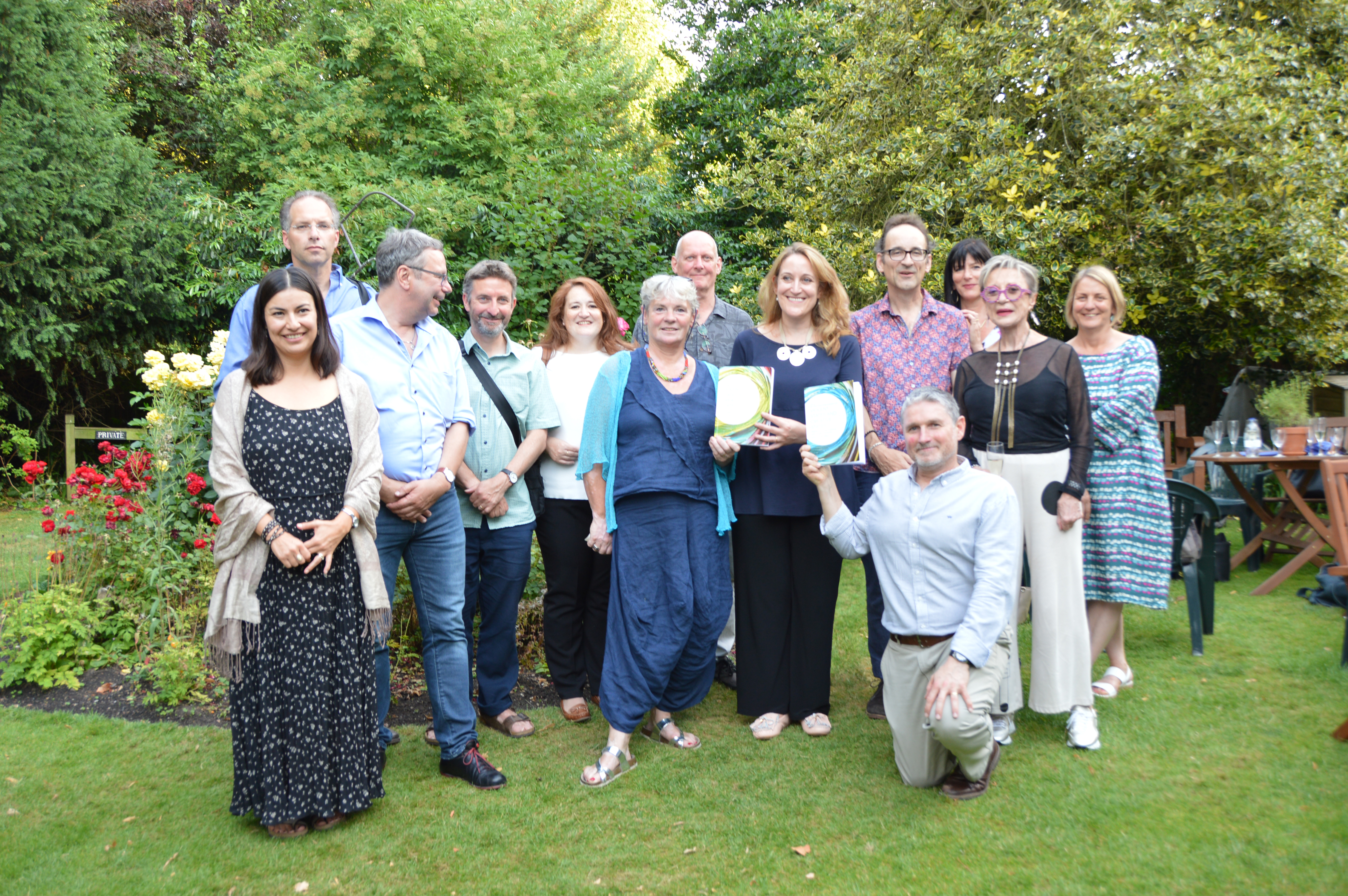
Violent States & Creative States Freud Museum authors group photo

Book Launch at the Freud Museum, 6 July 2018

(Some of the authors – from left to right: Gina Donoso; Wayne Martin; Tilman Kluttig; David Jones; Sarita Bose; Lucy Neal; Alex Maguire; Maggie MacAlister; John Adlam; Gerard Drennan; Anna Motz; Estela Welldon; Tamsin Cottis)